Follow-up Training Program · 11 min read
Follow-Up Training After Meniscus Surgery: Resection or Repair — Two Paths Back
How follow-up training differs after a partial meniscus resection and after a meniscus repair: phase table, loading steps and a realistic timeline.
- Published:
- Author:
- Julio Abad Veria, Sports Therapist · Sports Scientist
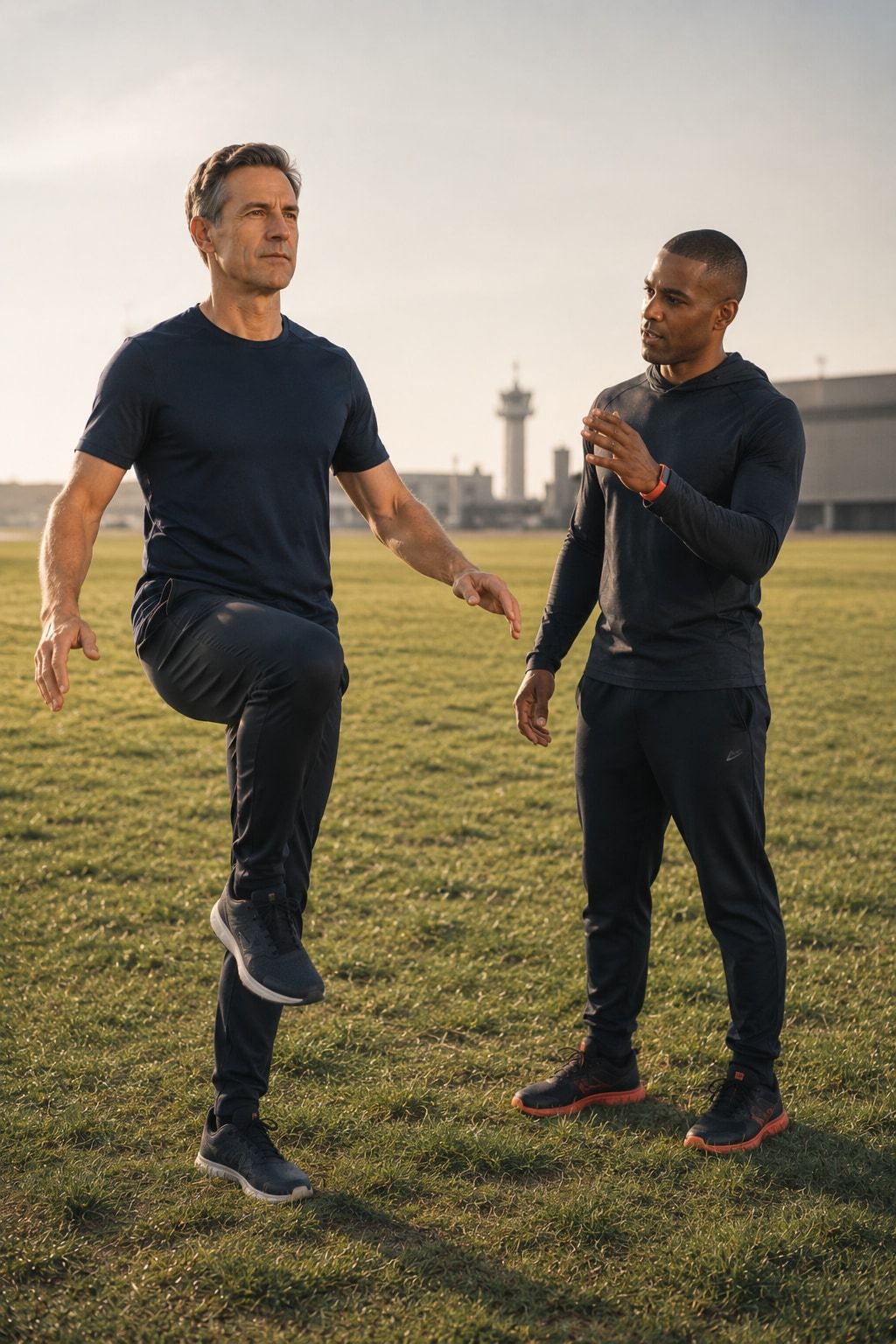
Note: This article does not replace medical advice. Written clearance from the treating physician is strictly required before any training is started after a meniscus operation. Follow-up training is not a medical treatment and not remedial gymnastics — it is sports-science-based training guidance after completed medical rehabilitation.
What Follow-Up Training After Meniscus Surgery Really Is
A meniscus operation is the most common arthroscopic procedure on the knee. But “meniscus surgery” is not a unique term — it covers two very different procedures whose follow-up training has hardly anything in common: the partial resection (removal of the torn portion) and the repair (refixation of the tear). Which procedure was performed is documented in the operative report and governs every step of the training guidance.
A follow-up training program closes the gap between medical aftercare — physiotherapy, out-patient follow-up rehabilitation — and the return to everyday and sporting life. It is not a medical treatment, not physiotherapy and not a substitute for medical care. It is sports-science-based training guidance with clear, measurable loading steps — based on medical clearance.
If you are looking for an overview of all four knee surgery types (TKR, ACL, meniscus, cartilage), you will find it in the pillar article on training after knee surgery. This article focuses on the meniscus pathway — and above all on the difference between resection and repair, which is blurred far too often in many rehab recommendations.
Partial Resection vs. Repair — Two Very Different Pathways
In Germany both procedures are clinically used today. The choice depends on tear location, tear pattern, patient age, accompanying injuries and the biological healing prospects.
Partial Meniscus Resection (Meniscectomy)
In a partial resection the torn portion is arthroscopically removed; the remaining tissue is preserved. The knee is usually fully load-bearing from the day of surgery, the swelling subsides within 1 to 2 weeks, and the gait normalises quickly. Follow-up training can start early — studies show a mean return-to-sport of 7 to 9 weeks; for medial meniscus resection even 3 to 6 weeks, for lateral meniscus 5 to 18 weeks.
The trade-off: anyone who loses a portion of their meniscus also loses a piece of shock absorption in the joint. Systematic reviews document an elevated osteoarthritis risk compared with the repair variant. Follow-up training cannot reverse this biological loss — but it can improve functional load capacity and so help prevent secondary damage.
Meniscus Repair (Meniscus Refixation)
In a repair the tear is sewn back together with sutures or implants — a biological repair that requires 4 to 6 months of healing time. The knee is typically partially loaded for 4 to 6 weeks (often with a 20 kg specification), with flexion limited to 0–90° in the first 6 weeks. Background: flexion beyond 90° under load creates roughly four times the standing load on the posterior horn of the meniscus — which jeopardises the fresh repair.
Follow-up training accordingly starts later (typically from week 6 to 8 after surgery) and with markedly more cautious progression. The mean return-to-sport reported in systematic reviews is 5.6 months, with a return rate to the previous activity level of 81 to 89 percent.
In both cases: the training plan must fit the procedure chosen — a generic “meniscus training” without knowledge of the surgical type and the medical restrictions is not sufficient in the follow-up phase.
Rehab Phases Overview — Both Pathways Compared
The table below shows typical reference values. Binding is always the medical clearance.
| Phase | Partial resection (reference) | Repair (reference) | Content |
|---|---|---|---|
| 0 | Day of surgery to week 1 | Day of surgery to week 6 | Wound healing, swelling control, partial loading (repair only) |
| 1 | Week 1–4 | Week 6–10 | Strength foundation, movement security, gait training |
| 2 | Week 4–8 | Week 10–16 | Functional loading, endurance, step progression |
| 3 | from week 8 | from month 4 | Sport-specific demands, return-to-sport tests |
VERTEX comes in at the transition from phase 0 to phase 1 — for partial resection roughly from week 1 to 2 after surgery, for repair typically from week 6 to 8 after surgery.
Phase 1: Strength Foundation and Movement Security
In the first weeks after the end of medical rehab, the goal is not performance but the restoration of a load-bearing movement foundation.
- Isometric quadriceps activation in sitting (hold times 5–10 seconds, 3 sets) — for the repair within a pain-free ROM range
- Guided mini-squats (depth limited: partial resection up to 60°, repair strictly up to 90°)
- Hip-hinge foundation with a bar without load (Romanian deadlift pattern) — pelvic stability
- Balance exercises in bilateral stance on an unstable surface
- Stationary bike endurance with a high saddle (low flexion), 10–15 min, Borg 10–12
What does not yet take place in phase 1: single-leg jumps, rapid changes of direction, maximum knee bends, deep squats under load, contact sport.
Phase 2: Building Functional Load
As soon as the basic movements are pain-free and safe, the transition to functional loading begins.
- Bulgarian split squat with the operated leg behind — submaximal with bodyweight, then progressively with a goblet load (3 × 8–10, Borg 13–14)
- Step-up variations with progressive step height (15 → 20 → 25 cm)
- Leg press with submaximal load within a pain-free ROM
- Single-leg Romanian deadlift for the posterior chain
- Endurance on a cross-trainer or stationary bike, low to moderate intensity (Borg 12–14)
Specifically for the repair variant: jumps and deep squats remain excluded in this phase — the biological healing of the repair is not yet complete.
Phase 3: Sport-Specific Demands, Return-to-Sport Tests
From phase 3 onward, strength is systematically increased and complemented with sport-specific stimuli — for partial resection from week 8, for repair from month 4.
- Single-leg squat at the wall or with TRX, pain-free range
- Low-impact plyometrics from phase 3 (pogo hops, tap drills on a step platform) — for the repair only after clinical clearance
- Reactive leg-axis control: single-leg stand with disrupted attention (ball throwing)
- Sport-specific movement patterns (for runners: controlled standing-start sprints, butt kicks; for cyclists: climbs out of the saddle; for tennis players: lateral steps)
For the return to running after meniscus surgery: with resection, progressive walk/jog from week 4 to 6; with repair, from month 3 to 4. The full 8-week walk/jog protocol with pre-run tests and Berlin running locations is described in our cluster article: Return to Running After Knee Surgery.
Steering Load Correctly: Borg, ROM, LSI
Three sports-science tools make the difference between “training somehow” and “demonstrable progress”:
Borg scale 6–20 for subjective load intensity. In follow-up training after meniscus surgery, values between 11 (“light”) and 14 (“somewhat hard”) count as the standard corridor in phase 1 and 2. This protects against reactive irritation of the joint and makes load comparable across weeks.
Range of Motion (ROM) as a rehab target. After a partial resection, full ROM is usually reached within 2 to 4 weeks. After a repair the flexion limit in the first 6 weeks is 90°, followed by progressive build-up until full flexion typically from month 3 to 4. If the ROM is not reached, the medical care side must react before any further training — follow-up training cannot close that gap.
Limb Symmetry Index (LSI) as a return-to-sport criterion. Comparison of strength or hop performance of the operated leg with the healthy leg. Threshold: LSI ≥ 80 percent for moderate sport return (jogging, cycling), ≥ 90 percent for recreational pivoting sport, ≥ 95 percent for competitive pivoting sport. Measurable through isokinetic strength tests and single-leg hop tests.
When May I Do What Again? — Return by Sport
The reference values below apply to an uncomplicated course. Binding is always the medical clearance.
| Sport | Partial resection | Repair | Note |
|---|---|---|---|
| Stationary bike (high saddle) | from week 1–2 | from week 6–8 | Low cadence, pain-free ROM |
| Swimming (crawl/back — no breaststroke) | from week 2–3 | from week 8–10 | Breaststroke kick loads the medial ligament strongly |
| Outdoor cycling (flat) | from week 3–4 | from week 10–12 | Saddle high enough, low cadence |
| Hiking on flat ground | from week 4 | from week 10 | Use poles, progress distance |
| Nordic walking | from week 4–6 | from week 12 | Active pole work, no downhill |
| Jogging (walk/jog protocol) | from week 4–6 | from month 3–4 | Pre-run tests strictly required first |
| Strength training (multi-joint) | from week 4–6 | from month 3 | Pain-free ROM, submaximal |
| Tennis doubles | from week 6–8 | from month 4–6 | Singles later, high torques |
| Football, handball, basketball (training) | from week 6–9 | from month 4–6 | Only after passing the LSI test battery |
| Competition in pivoting sport | from week 9–12 | from month 5–7 | Only after LSI ≥ 90 %, written clearance |
| Alpine skiing | from month 3 | from month 5–6 | High torsional and impact loading |
These recommendations follow data from the German Journal of Sports Medicine and international systematic reviews (see sources) and serve as orientation — not as therapy recommendations.
Three Typical Pitfalls
- Ramping up too early after a partial resection. Because the knee is pain-free, a return after 3 weeks feels tempting. But reactive irritation of the joint capsule and cartilage surface often only shows up days later — as an “odd pulling” at the next training session, which then costs another four weeks. Patience in weeks 3 to 4 is the most reliable investment in week 8.
- Ignoring the flexion limit after a repair. “90° doesn’t hurt, so 100° will be fine too” — until the repair tears. The flexion limit is not a question of sensation, but a biomechanical specification. Deep squats, heel sitting and climbing stairs with full flexion of the operated leg should be strictly avoided in the first 6 weeks.
- Missing re-test points. Without clear measurement points (LSI, ROM, pain-free squat depth, single-leg hop), progress cannot be assessed objectively. After 6 weeks of follow-up training a first re-test should take place, before the return to sport a second — that is the difference between “feels better” and “measurably load-capable”. A movement assessment makes such asymmetries visible.
Follow-Up Training After Meniscus Surgery in Berlin
VERTEX SPORTTHERAPIE offers 1-on-1 follow-up training after meniscus surgery in several Berlin studios — and, for outdoor-oriented phase 3 sessions, also at Tempelhofer Feld, in Volkspark Friedrichshain or in Lietzenseepark. With studio locations in Mitte, Charlottenburg, Friedrichshain, Prenzlauer Berg and Kreuzberg, VERTEX is reachable by public transport for most self-paying clients. Sessions take place in German, English or Spanish — a rare combination in Berlin. Anyone who wants to start with water training in the early repair phase will find aqua jogging and joint-friendly water strength in our Aqua Movement Training service line. For repair patients heading back into sport, the transition into Return to Sport from phase 3 onward is the right next step.
Follow-up training is a self-pay service. Transparent rates are on the Pricing page, and a candid market overview is in the PDF What Does Private Sports Therapy Cost in Berlin?. A 15-minute initial call is free of charge and clarifies whether VERTEX is the right fit for the specific surgical variant, the medical clearance and the target sport.
What a Follow-Up Training Program Cannot Do
A follow-up training program is not a therapy and replaces neither out-patient rehab nor medical aftercare. With persistent pain, swelling, restricted range of motion, warmth or redness in the surgical area or any unclear symptoms, consulting the operating physician is essential.
What a well-structured follow-up training program does offer: a reliable, criterion-based path from medical care back into sport — with measurable progress, clear loading steps and a realistic timeline that fits the surgical variant and your life situation.
Frequently Asked Questions
-
When can I do sport again after a partial meniscus resection?
After a pure partial resection, full loading is usually possible from day 1; cycling or swimming with a crawl or backstroke kick from week 2 to 4. Jogging and low-contact sports are typically cleared from week 4 to 6, pivoting sports such as football or singles tennis from week 6 to 9. International study data show a mean return-to-sport between 7 and 9 weeks — binding is always the written clearance from the operating physician. -
When can I do sport again after a meniscus repair?
After a meniscus repair, the earliest realistic start of sport is 3 to 4 months later; the mean return-to-sport reported in systematic reviews is around 5.6 months. Contact and pivoting sports (football, handball, basketball, singles tennis) are typically cleared only from month 4 to 6 — and only if strength and function tests in the operated leg reach values comparable to the healthy leg. -
What is the difference between resection and repair for my training?
In a partial resection (meniscectomy) the torn portion is removed — the remaining tissue is immediately load-bearing and rehabilitation is accelerated. In a repair (refixation) the tear is sewn back together and has to heal biologically — that requires 6 weeks of partial loading, a flexion limit at 90° and an overall rehabilitation about five times longer. Which procedure the surgeon chose is documented in the operative report and governs every step of the follow-up training. -
How long does the knee need a brace and crutches after a meniscus repair?
Typical are 4 to 6 weeks of partial loading with forearm crutches plus a brace with the flexion limit set to 90 degrees — that is part of the medical aftercare, not of follow-up training. The exact duration depends on tear location, repair technique and individual course. Follow-up training only starts after partial loading has ended and after written clearance from the clinic. -
Why may the knee only be bent to 90° in the first weeks after a meniscus repair?
Flexion beyond 90° under load creates roughly four times the standing load on the posterior horn of the meniscus — which jeopardises the fresh repair. Standard protocols (see Calanna et al. 2022) therefore limit active flexion in the first 6 weeks to 0–90°. Deeper flexion is rebuilt only after clinical clearance and gradually within the follow-up training. -
When can I jog again after meniscus surgery?
After a partial resection typically from week 4 to 6 — provided the gait is limp-free, quadriceps strength of the operated leg reaches at least 80 percent of the healthy leg and a 5-minute walking test remains pain-free. After a meniscus repair no earlier than month 3 to 4 and only via a progressive walk/jog protocol — the running build-up is described in detail in our [cluster article: Return to Running After Knee Surgery](/en/knowledge/return-to-running-after-knee-surgery/). -
Do health insurers cover follow-up training after meniscus surgery?
Rehabilitation sport under § 64 SGB IX is, with a medical prescription, available as a benefit-in-kind through an approved club — typically in a group setting, which often does not meet the individual load limits after a meniscus repair. Privately delivered 1-on-1 follow-up training is a self-pay service. Some private health insurers and government allowance schemes refund personal training with a rehabilitation focus on a pro-rata basis — clarifying the conditions with your specific plan before training begins is advisable. -
Does the osteoarthritis risk rise after a meniscus operation?
Yes — especially after a partial resection, systematic reviews show an elevated osteoarthritis risk compared with the repair variant. Background: the meniscus distributes load within the joint; every portion removed reduces this shock absorption. Structured follow-up training with quadriceps build-up, leg-axis control and weight management cannot eliminate the risk, but can markedly improve functional load capacity.
This service in detail
Follow-up Training Program — structured training guidance with Julio
If you would like to apply this knowledge in your daily life — Julio guides you 1-on-1 through every phase. Initial call free of charge, available in DE / EN / ES.
Scientific Sources
This content is based on the following guidelines, systematic reviews and specialist publications:
- 1. Rehabilitation and return to sports after isolated meniscal repairs: a new evidence-based protocol Journal of Experimental Orthopaedics / PMC (Calanna, Duthon, Menetrey), 2022
- 2. Return-to-Play and Rehabilitation Protocols Following Isolated Meniscal Repair — A Systematic Review Orthopaedic Journal of Sports Medicine / PMC, 2021
- 3. Time to Return to Sports After Different Meniscus Operations German Journal of Sports Medicine (DGSP), 2019
- 4. Partial Meniscectomy and Return to Sport GOTS — German-Austrian-Swiss Society for Orthopaedic Traumatologic Sports Medicine, 2023
- 5. Surgery After a Meniscus Tear: Resection or Repair? Gelenk-Klinik Gundelfingen, 2024
- 6. Meniscal Repair Rehabilitation Protocol Lahey Hospital & Medical Center, Department of Orthopaedic Surgery, 2022
- 7. Osteoarthritis Development Following Meniscectomy vs. Meniscal Repair for Posterior Medial Meniscus Injuries: A Systematic Review PMC / Systematic Review, 2024
- 8. S2k Guideline Indication for Total Knee Endoprosthesis (EKIT-Knee) AWMF / DGOU / DGOOC, 2023
About the author
Julio Abad Veria
Sports Therapist · Sports Scientist
Julio completed a five-year university degree in Sports Science in Cuba, officially recognised in Germany as a Sportwissenschaftler by the Central Office for Foreign Education (ZAB). For 14 years he has worked in in-patient and out-patient rehabilitation centres in Berlin — today with a focus on 1-on-1 follow-up training after completed medical care.
Continuing education relevant to this topic:
- Physiotherapy on equipment — clinical pictures
- Movement therapy for oncological conditions
- Aqua Trainer Basic
Related articles
-
Follow-up Training Program
Training After Knee Surgery: the Follow-Up Program for the First 12 Weeks
Structured rebuilding of knee function after completed medical care: 12-week follow-up training for TKR, ACL and meniscus, with a sport-by-sport return plan.
-
Follow-up Training Program
Follow-Up Training After ACL Surgery: the 9-Month Plan Back to Sport
Structured training phases after ACL reconstruction (patellar tendon, hamstring, quadriceps tendon): from crutch weaning to return-to-sport — criteria, tests, realistic timeline.
-
Return to Sport
Return to Running After Knee Surgery in Berlin: 8-Week Walk/Jog Program and Pre-Run Tests
8-week walk/jog program after knee surgery: three pre-run tests, running technique and concrete Berlin parks — criterion-based for ACL, meniscus and TKR.
- Universitäts-Diplom anerkannt Anabin / ZAB Zeugnisbewertung
- 9 Jahre in Berlin
- Aqua Trainer Basic Fortbildungs-Zertifikat
- KG-am-Gerät-Fortbildung Fortbildungs-Zertifikat
- Onkologische Bewegungstherapie-Fortbildung Fortbildungs-Zertifikat
Schwestermarke
Sie suchen ein Programm für Ihr Unternehmen, Pflegeheim oder Ihre Praxis?
MOVETICA — die Schwestermarke für B2B-Bewegungs- und Gesundheitsprogramme. Reha, Firmenfitness, Seniorenbewegung, Prävention, Aquatherapie.
MOVETICA ist eine zweite Marke desselben Inhabers Julio Abad Veria. Beide Marken bedienen unterschiedliche Zielgruppen und Angebote: VERTEX richtet sich an private Endkunden (B2C), MOVETICA an Organisationen (B2B).