Follow-up Training Program · 12 min read
Training After Knee Surgery: the Follow-Up Program for the First 12 Weeks
Structured rebuilding of knee function after completed medical care: 12-week follow-up training for TKR, ACL and meniscus, with a sport-by-sport return plan.
- Published:
- Author:
- Julio Abad Veria, Sports Therapist · Sports Scientist
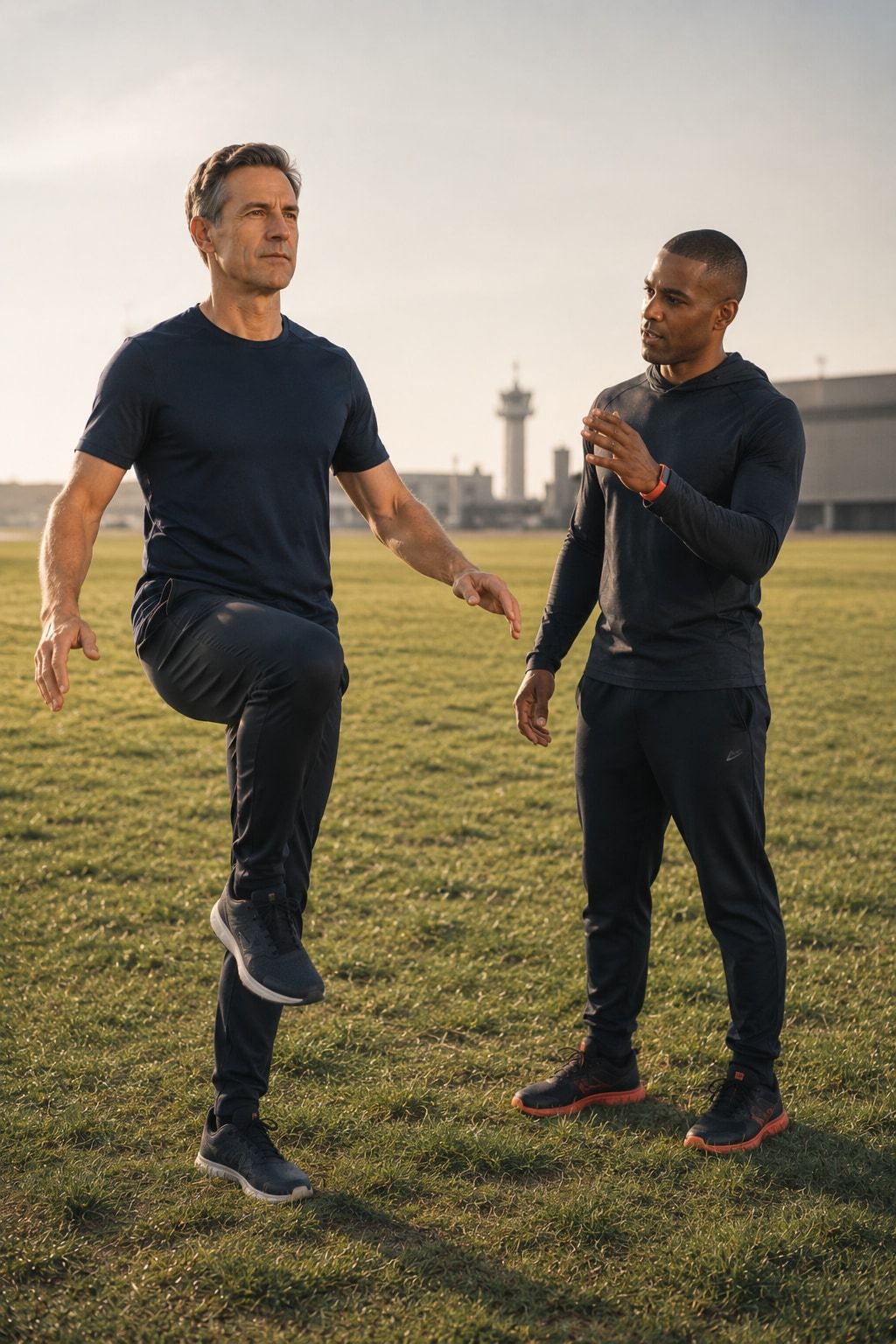
Note: This article does not replace medical advice. Written clearance from the treating physician is strictly required before any training is started after knee surgery. A follow-up training program is not a medical treatment and not physiotherapy — it is sports-science-based training guidance after completed medical rehabilitation.
What Follow-Up Training After Knee Surgery Really Is — and What It Is Not
After knee surgery and the subsequent medical rehabilitation (in Germany typically 3 weeks in-patient or 4 weeks out-patient rehabilitation, known as AHB), many patients suddenly feel left to their own devices. The knee is “medically taken care of”, but it often remains unstable in everyday life, weaker than the healthy leg and at times still slightly irritable.
A follow-up training program closes the gap between completed medical rehab and normal everyday or sporting life. It is:
- not a substitute for physiotherapy or remedial gymnastics
- not a medical treatment and not pain therapy
- not a diagnostic service
Instead: sports-science-based, structured training guidance — building strength, movement security and load capacity on the basis of medical clearance. It is precisely in the weeks after rehab that long-term knee stability is decided — or that setbacks occur.
Four Knee Surgeries, Four Training Paths — a Short Overview
The term “knee surgery” covers very different procedures. Training plan, timeline and permissible loads differ substantially. Before any follow-up training, it must be clear which procedure was performed and what restrictions the operating clinic has set.
Total Knee Replacement (TKR)
In a TKR the joint surfaces of femur and tibia, and usually the back of the kneecap, are replaced with an artificial joint. Rehabilitation sport typically begins 6 to 8 weeks after surgery; strength training is progressed slowly and in a controlled manner. Low-impact sports are recommended over the long term; impact-loaded movements should be reduced because they influence the lifespan of the implant.
ACL Reconstruction
After reconstruction of the anterior cruciate ligament (usually with patellar tendon or semitendinosus graft) a longer, phase-oriented rehabilitation follows. Return to pivoting sports such as football, handball or basketball is, as a rule, only cleared after 9 to 12 months at the earliest — and even then only when the Limb Symmetry Index in strength and hop tests reaches the relevant values.
Meniscus Resection or Meniscus Repair
After a partial resection the load progression is significantly faster (often full loading from day 1, sport after 4 to 6 weeks). After a meniscus repair the knee is partially loaded for 4 to 6 weeks, and knee flexion is restricted in the first weeks — follow-up training starts later and with markedly more cautious progression.
Cartilage Surgery (Microfracture, MACI)
Cartilage procedures need the longest period of caution: 6 to 12 weeks of partial loading, then very gradual load progression over 6 months. Plyometric and impact-loading stimuli are off-limits during this phase. Follow-up training is particularly sensitive here and requires close coordination with the operating clinic.
Rehabilitation Phases at a Glance
A typical knee follow-up program is organised in four phases:
| Phase | Time frame (guideline) | Content | Responsibility |
|---|---|---|---|
| 0 | Day of surgery to end of rehab | Wound healing, mobilisation, crutch weaning, physiotherapy on equipment | Physician, physiotherapy, AHB |
| 1 | from week 2–6 after rehab discharge | Strength foundation, movement security, gait training | Follow-up training |
| 2 | from week 6–12 | Functional loading, endurance, step progression | Follow-up training |
| 3 | from week 12 | Sport-specific demands, plyometrics only after re-testing | Follow-up training |
VERTEX comes in at the transition from phase 0 to phase 1 — after completed medical rehab and with written clearance, not a second earlier.
Phase 1 (Weeks 2–6 After Rehab Discharge): Strength Foundation and Movement Security
In the first weeks after rehab discharge the goal is not to maximise performance, but to regain trust in the leg.
- Isometric quadriceps activation in sitting and lying positions (hold times 5–10 seconds, 3 sets)
- Guided wall squats or with a TRX strap (depth limited to the pain-free range, typically 30–60° of flexion)
- Balance exercises in two-leg stance on an unstable surface (mat, balance pad)
- Gait re-education without limping — conscious step length, foot roll, pelvic stability
What matters in this phase: no plyometric jumps, no rapid changes of direction, no maximum strength loads. The stimuli are submaximal but precise — the goal is restored movement control, not muscle gain.
Phase 2 (Weeks 6–12): Building Functional Load
As soon as the basic movements are safe and pain-free, the transition to functional loading begins.
- Guided single-leg stand exercises (initially with wall contact, later free)
- Step-up variations with progressive step height (15 → 20 → 25 cm)
- Leg press or mini-squat with additional weight, if studio access is available
- Endurance in flat terrain on cross-trainer or stationary bike, low intensity (Borg scale 11–13)
For outdoor training Tempelhofer Feld is ideal: flat asphalt loop, no roots, easy to control. For trainees based in Friedrichshain, Volkspark Friedrichshain offers moderate gradients; in Charlottenburg, Lietzenseepark is a good option.
Phase 3 (From Week 12): Stabilisation Under Load and Sport-Specific Demands
From week 12 the strength load is increased systematically and supplemented with coordinative and sport-specific demands.
- Bulgarian split squat with the operated leg behind (3 × 8–10 repetitions per side)
- Single-leg squat at the wall or with TRX, pain-free range
- Reactive exercises with low impact: quick step changes, tap drills on a step platform
- Proprioceptive stimuli: single-leg stand on a wobble board, eyes-closed variant with wall safety
- Sport-specific movement patterns (for runners: high knees, butt kicks, controlled standing-start sprints; for cyclists: progressive gradients; for skiers: lateral hops at low height)
True plyometric jumps and maximum accelerations remain optional and are only cleared once symmetry between both legs has been demonstrated — see the next section.
Steering Load Correctly: Borg Scale, ROM Targets, LSI
Three sports-science tools make the difference between “training somehow” and “demonstrable progress”:
Borg scale 6–20 for training intensity. A subjective load scale that in follow-up training prescribes endurance sessions at values between 11 (“light”) and 13 (“somewhat hard”). This protects the sensitive knee from overload and makes load comparable across weeks — without a heart-rate monitor and without equipment.
Range of motion (ROM) as a rehab target. After a TKR a flexion of about 90° after 2 weeks, 110° after 6 weeks and at least 120° after 12 weeks is a useful benchmark. If the ROM is not reached, the medical rehab side must react before any further training — follow-up training cannot close that gap.
Limb Symmetry Index (LSI) as a return-to-sport criterion. The LSI compares strength or hop performance of the operated leg with that of the healthy leg. In the international sports-science literature (see sources at the end) an LSI of at least 90 % is named as the minimum threshold for returning to recreational sports; for pivoting contact sports such as football, handball or basketball, 100 % is recommended. Concretely measurable through isokinetic strength tests (quadriceps strength) and single-leg hop tests (single-leg hop distance).
At VERTEX these three metrics are recorded at every movement assessment — as a baseline at the start, and as a progress measurement every 6 weeks.
When May I Do What Again? — Return by Sport
The figures below refer to a TKR after an uncomplicated course; after ACL surgery the timelines are usually longer. Binding is always the medical clearance.
| Sport | Earliest re-entry | Note |
|---|---|---|
| Swimming (avoid breaststroke, prefer crawl / backstroke) | from week 6–8 | Breaststroke kick loads the medial ligament strongly |
| Aqua jogging | from week 6 | Very joint-friendly, ideal in phase 2 |
| Cycling (stationary bike, then flat outdoors) | from week 6–8 | Saddle high enough, low cadence |
| Hiking on flat ground | from week 8 | Use poles, progress distance gradually |
| Nordic walking | from week 10–12 | Active pole work, no downhill |
| Cross-country skiing (classic) | from month 4–6 | Avoid skating style |
| Dancing (partner, no spins) | from month 4 | Avoid jumps and rapid turns |
| Golf (with cart, not walking) | from month 6 | Swing rotation strongly loads the knee |
| Tennis doubles | from month 6–9 | Singles only after individual clearance |
| Jogging | not recommended after TKR | After ACL reconstruction: from month 4–6 |
| Alpine skiing, football, handball, basketball | case by case from month 9–12 | High torques, high reinjury risk |
These recommendations follow guidance from the German Society of Sports Medicine and Prevention (DGSP) and serve as orientation — not as therapy recommendations. For the early water-training phases we also offer Aqua Movement Training as a dedicated service line — joint-friendly and usable as soon as pool clearance is given.
Three Typical Pitfalls
- Jumping into load too quickly. Trying to jog again in week 4 risks reactive irritation around the implant bed or in the reconstructed cruciate ligament. Patience here is not a loss; it is the precondition for lasting stability.
- Asymmetric movement patterns. Many trainees unconsciously compensate with the healthy leg — when standing up, climbing stairs, sitting down. A movement assessment at the start makes such patterns visible and correctable. Without correction, the overload sooner or later moves into the healthy knee, the hip or the lower back.
- Missing re-test points. Without clear measurement points (LSI, ROM, Y-balance, pain-free squat depth) progress cannot be assessed objectively. After 6 weeks of follow-up training a first re-test should take place, after 12 weeks the second — that is the difference between “feels better” and “measurably load-capable”. For self-checks between sessions: our Mobility & Strength Self-Assessment guides you through 12 structured tests in 20 minutes.
Follow-Up Training After Knee Surgery in Berlin
VERTEX SPORTTHERAPIE offers 1-on-1 follow-up training in several Berlin studios and, where transit links allow, in clients’ homes too. With studio locations in Mitte, Charlottenburg, Friedrichshain, Prenzlauer Berg and Kreuzberg, VERTEX is reachable within 30 minutes by public transport for most self-paying clients. Sessions are available in German, English or Spanish — a rare combination in Berlin.
Follow-up training is a self-pay service. Some private health insurers and government allowance schemes reimburse personal training with a rehabilitation focus on a pro-rata basis — clarifying this with your specific plan before starting is sensible. Transparent rates are on the Pricing page, and a candid market overview is in the PDF What Does Private Sports Therapy Cost in Berlin?. A 15-minute initial call is free of charge and clarifies whether VERTEX is the right fit for your particular surgery, your medical clearance and your daily life.
What a Follow-Up Training Program Cannot Do
A follow-up training program is not a therapy and replaces neither out-patient rehab nor medical aftercare. If you experience persistent pain, swelling, restricted range of motion, warmth or redness in the surgical area, or any unclear symptoms, you must consult the operating physician — those are not signals to train through.
What a well-structured follow-up training program does offer: a reliable transition from medical care to everyday life and to sport, with measurable progress and a clear training plan that fits your life situation.
Frequently Asked Questions
-
When can I start strength training again after knee surgery?
This depends on the type of surgery and how the medical rehabilitation went. After a total knee replacement (TKR), structured rehabilitation sport or follow-up training typically begins between weeks 6 and 8; after ACL reconstruction usually between weeks 6 and 12. What matters is always the written clearance of the treating physician — not the rehab discharge letter alone. -
How long does the full rehabilitation after knee surgery take?
In Germany the medical follow-up rehabilitation (AHB) lasts as a rule 3 weeks in-patient or 4 weeks out-patient. Until full everyday and sporting load capacity is restored, an additional 6 to 12 months typically pass depending on the surgery. The follow-up training after the medical rehab usually accompanies this period for 12 to 24 weeks. -
Which sports are recommended after a total knee replacement — and which are not?
Recommended are low-impact sports: swimming, aqua jogging, cycling, hiking on flat ground, dancing and cross-country skiing. Less recommended are high-impact sports with strong rotational movements such as singles tennis, squash, football, handball, basketball, volleyball, alpine skiing and jogging. The final clearance for each sport remains a medical decision. -
When am I allowed to jog again after knee surgery?
After ACL reconstruction typically from month 4 to 6, with medical clearance and provided that strength in the operated leg has reached at least 90 percent of the healthy leg (Limb Symmetry Index). After a TKR jogging is usually not recommended because the repeated impact can shorten implant longevity. -
Which exercises should I initially avoid after knee surgery?
In the first 6 to 12 weeks after rehab discharge, plyometric jumps, deep squats beyond 90 degrees, rapid changes of direction, maximum strength loads and contact sport are all off limits. Heavy leg-press loading and single-leg jumps belong only to later phases — and only after explicit medical and sports-scientific clearance. -
How long are crutches typically needed after knee surgery?
After a TKR usually 2 to 6 weeks of partial loading with forearm crutches, after ACL reconstruction 2 to 4 weeks depending on the surgical technique. The crutch weaning phase is part of the medical rehabilitation — follow-up training only starts once full loading has been cleared and a gait without limping is possible. -
What does a Limb Symmetry Index above 90 percent mean for the return to sport?
The Limb Symmetry Index (LSI) compares strength or hop performance of the operated leg with that of the healthy leg. In the sports-science literature an LSI of at least 90 percent is considered the minimum criterion for returning to recreational sports; for pivoting contact sports (football, handball, basketball) 100 percent is recommended. Studies show that respecting this threshold significantly reduces the risk of reinjury. -
Do health insurers cover follow-up training after knee surgery?
Rehabilitation sport under § 64 SGB IX is, with a medical prescription, available as a benefit-in-kind through an approved club. Privately delivered 1-on-1 follow-up training is a self-pay service. Some private health insurers and government allowance schemes refund personal training with a rehabilitation focus on a pro-rata basis — clarifying this with your specific plan before training begins is advisable.
This service in detail
Follow-up Training Program — structured training guidance with Julio
If you would like to apply this knowledge in your daily life — Julio guides you 1-on-1 through every phase. Initial call free of charge, available in DE / EN / ES.
Scientific Sources
This content is based on the following guidelines, systematic reviews and specialist publications:
- 1. S2k Guideline Indication for Total Knee Endoprosthesis (EKIT-Knee) AWMF / DGOU / DGOOC, 2023
- 2. Sport after Hip and Knee Endoprosthesis: What Do We Allow? Universimed Orthopaedics & Traumatology, 2024
- 3. Sport Load and Load Capacity after Endoprosthetic Joint Replacement German Journal of Sports Medicine (DGSP), 2009
- 4. Continuous Passive Motion after Knee Replacement Surgery (Cochrane Review CD004260) Cochrane Database of Systematic Reviews, 2014
- 5. Effectiveness of Physiotherapy Exercise Following Total Knee Replacement: Systematic Review and Meta-Analysis BMC Musculoskeletal Disorders / PMC, 2015
- 6. Return to Sport Following Anterior Cruciate Ligament Reconstruction: A Scoping Review of Criteria Determining Return-to-Sport Readiness Journal of Orthopaedic & Sports Physical Therapy (PubMed), 2024
- 7. Limb Symmetry Indexes Can Overestimate Knee Function After Anterior Cruciate Ligament Injury Journal of Orthopaedic & Sports Physical Therapy, 2017
- 8. Return to Sport after Endoprosthetics Sportärztezeitung, 2023
About the author
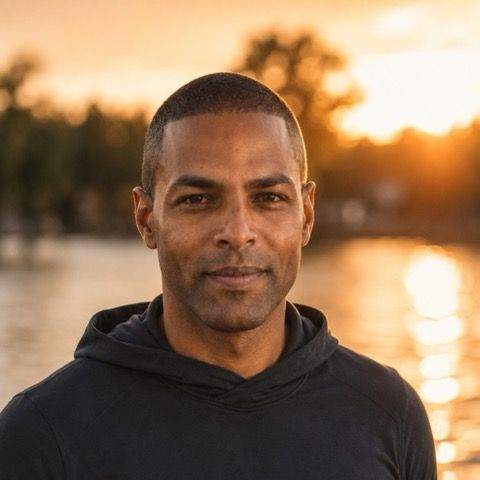
Julio Abad Veria
Sports Therapist · Sports Scientist
Julio completed a five-year university degree in Sports Science in Cuba, officially recognised in Germany as a Sportwissenschaftler by the Central Office for Foreign Education (ZAB). For 14 years he has worked in in-patient and out-patient rehabilitation centres in Berlin — today with a focus on 1-on-1 follow-up training after completed medical care.
Continuing education relevant to this topic:
- Physiotherapy on equipment — clinical pictures
- Movement therapy for oncological conditions
- Aqua Trainer Basic
Related articles
-
Follow-up Training Program
Follow-Up Training After a Total Knee Replacement: Strength Training, Sports and Fall Prevention
Structured training program after a total knee replacement: phases, exercises, Borg/ROM/LSI metrics, a 14-sport return table and fall prevention for seniors 60+.
-
Follow-up Training Program
Follow-Up Training After ACL Surgery: the 9-Month Plan Back to Sport
Structured training phases after ACL reconstruction (patellar tendon, hamstring, quadriceps tendon): from crutch weaning to return-to-sport — criteria, tests, realistic timeline.
-
Follow-up Training Program
Follow-Up Training After Meniscus Surgery: Resection or Repair — Two Paths Back
How follow-up training differs after a partial meniscus resection and after a meniscus repair: phase table, loading steps and a realistic timeline.
-
Return to Sport
Return to Running After Knee Surgery in Berlin: 8-Week Walk/Jog Program and Pre-Run Tests
8-week walk/jog program after knee surgery: three pre-run tests, running technique and concrete Berlin parks — criterion-based for ACL, meniscus and TKR.
- Universitäts-Diplom anerkannt Anabin / ZAB Zeugnisbewertung
- 9 Jahre in Berlin
- Aqua Trainer Basic Fortbildungs-Zertifikat
- KG-am-Gerät-Fortbildung Fortbildungs-Zertifikat
- Onkologische Bewegungstherapie-Fortbildung Fortbildungs-Zertifikat
Schwestermarke
Sie suchen ein Programm für Ihr Unternehmen, Pflegeheim oder Ihre Praxis?
MOVETICA — die Schwestermarke für B2B-Bewegungs- und Gesundheitsprogramme. Reha, Firmenfitness, Seniorenbewegung, Prävention, Aquatherapie.
MOVETICA ist eine zweite Marke desselben Inhabers Julio Abad Veria. Beide Marken bedienen unterschiedliche Zielgruppen und Angebote: VERTEX richtet sich an private Endkunden (B2C), MOVETICA an Organisationen (B2B).