Follow-up Training Program · 12 min read
Follow-Up Training After ACL Surgery: the 9-Month Plan Back to Sport
Structured training phases after ACL reconstruction (patellar tendon, hamstring, quadriceps tendon): from crutch weaning to return-to-sport — criteria, tests, realistic timeline.
- Published:
- Author:
- Julio Abad Veria, Sports Therapist · Sports Scientist
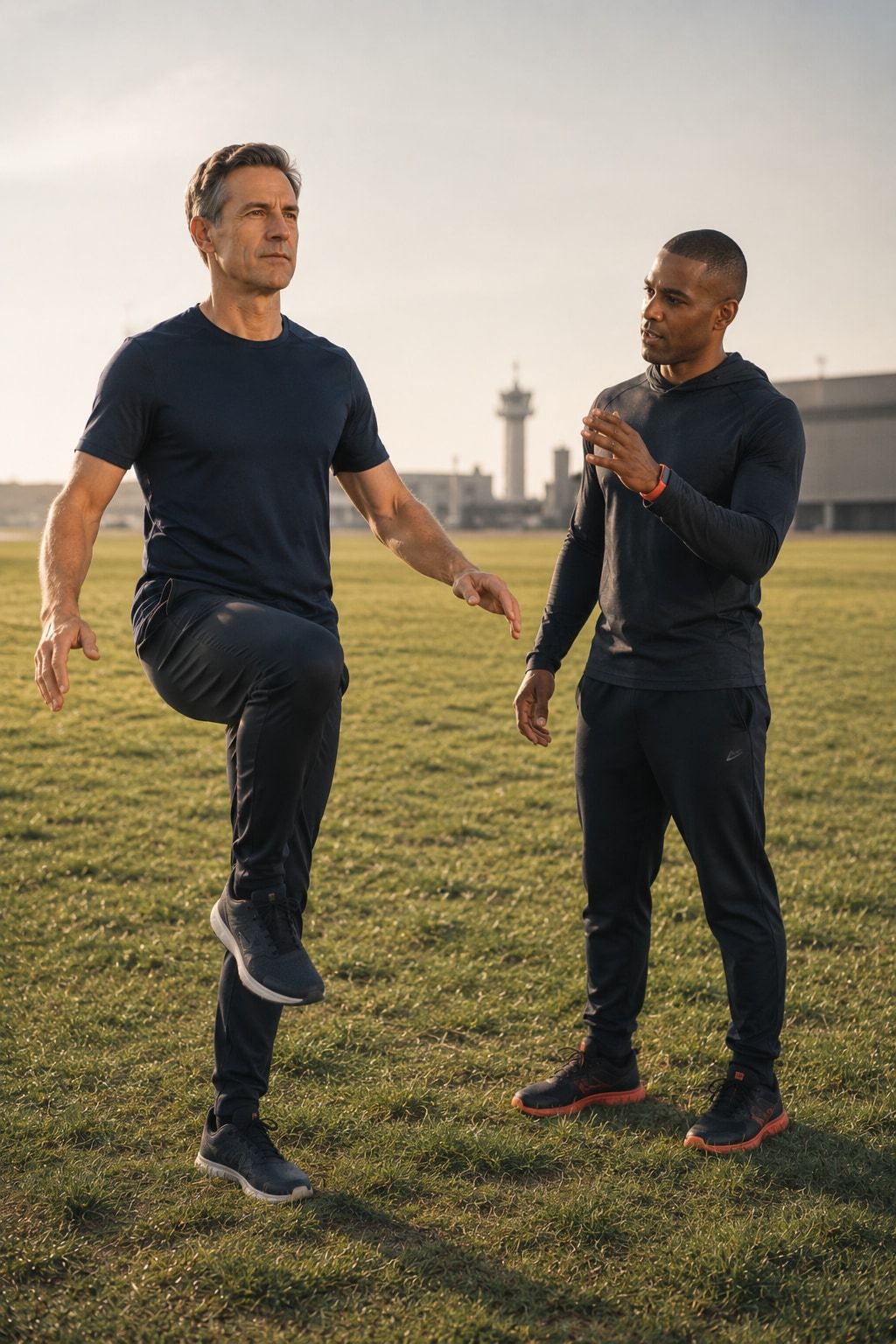
Note: This article does not replace medical advice. Written clearance from the treating physician is strictly required before any training is started after ACL surgery. A follow-up training program is not a medical treatment and not physiotherapy — it is sports-science-based training guidance after completed medical rehabilitation.
What Really Matters After ACL Surgery
A reconstruction of the anterior cruciate ligament (ACL graft surgery) is the only knee injury for which the medical standard recommendation reads “no return to contact sport before month 6” — and for which reinjury rates of 15 to 30 percent are documented. What makes the difference between successful return and a second surgery is rarely the operative course itself — it is discipline during weeks 12 to 26 after surgery.
A follow-up training program after ACL surgery is the structured training guidance during exactly that phase. It does not replace medical treatment, it is not physiotherapy and not remedial gymnastics. It is sports-science-based guidance with clear, measurable loading steps — based on medical clearance and in coordination with the operating clinic.
If you are looking for an overview of all four knee surgery types (TKR, ACL, meniscus, cartilage), see our pillar article on training after knee surgery. This article focuses on the ACL pathway.
Which Graft Variant Was Chosen? Three Pathways
Three graft variants are in clinical use in Germany today. Which one the surgeon chose is recorded in the operative report and shapes the first 6 to 12 weeks of follow-up training.
Patellar Tendon Graft (BPTB — Bone-Patellar Tendon-Bone)
The gold standard for a long time. Lowest re-rupture rate, very strong fixation. Trade-off: more frequent anterior knee pain (so-called “donor-site morbidity”) in the first 6 months, especially when kneeling or under load on the kneecap. Follow-up training compensates for this with early patella mobilisation and targeted quadriceps activation in pain-free flexion angles.
Hamstring Graft (Semitendinosus, Often with Gracilis)
Fewer donor-site complaints at the front of the knee, but slower strength recovery in the flexor muscles. Hamstring strength tests often remain slightly asymmetric until month 12. Follow-up training for hamstring grafts puts noticeably more volume into hamstring-specific exercises (Nordic curls, Romanian deadlift, glute-ham raise — all only from phase 3 onward).
Quadriceps Tendon Graft
A more modern alternative with low donor-site morbidity and good clinical data. Quadriceps activation in the first 6 weeks is more sensitive than with the other two variants because the tendon is harvested from above — follow-up training therefore starts with particularly gentle isometric quadriceps work.
In all three cases the same applies: the training plan and load progression must match the chosen graft — that is standard knowledge in any experienced sports therapy practice. A generic “knee training” without knowledge of the graft is not sufficient in the follow-up phase.
Rehabilitation Phases at a Glance
A typical follow-up program after ACL graft surgery is organised in five phases, the first two of which take place during medical rehab:
| Phase | Time frame (guideline) | Content | Responsibility |
|---|---|---|---|
| 0 | Day of surgery to week 2 | Wound healing, ROM start, partial loading on crutches | Clinic / surgeon |
| 1 | Week 2–6 | Full active extension, flexion to 90°, quadriceps activation | Medical rehab (AHB) |
| 2 | Week 6–12 | Full loading, bilateral strength training, stationary bike | Follow-up training |
| 3 | Week 12–26 | Single-leg strength, first plyometrics, running build-up | Follow-up training |
| 4 | from week 26 | Return-to-sport tests, sport-specific stimuli | Follow-up training |
VERTEX typically comes in at the transition from phase 1 to phase 2 — that is, around week 6 to 8 after surgery, after completed medical AHB and with written clearance.
Phase 2 (Weeks 6–12): Full Loading, Bilateral Strength Training Begins
In this phase the knee is usually pain-free in extension and in moderate flexion. The goal is not maximum strength but the restoration of a load-capable movement foundation.
- Bilateral squat with body weight, then with goblet-squat load (kettlebell), progressively increasing depth to 90°
- Leg press with submaximal load (Borg 12–14)
- Hip-hinge patterns (Romanian deadlift with bar, light) — decisive for later running mechanics
- Stationary bike endurance 20–30 min, cadence 70–90, low resistance
- Core stabilisation: plank variations, dead bug, bird dog
Water-based training can ease the transition here — see our Aqua Movement Training line for aqua jogging and joint-friendly strength work in water.
What does not yet happen in phase 2: single-leg jumps, rapid changes of direction, maximum squats, contact sport in any form.
Phase 3 (Weeks 12–26): Single-Leg Strength, Plyometrics, Running Build-Up
The longest and most decisive phase. This is where the mistakes happen that become expensive later on.
- Bulgarian split squat with the operated leg behind — progressively with added weight (3 × 8–10 repetitions, Borg 14–16)
- Single-leg Romanian deadlift for the posterior chain
- Step-up with progressive height (20 → 30 → 40 cm) and slow addition of weight
- Low-impact plyometrics from week 16: pogo hops, tap drills, then progressive box jumps with controlled landing (soft roll-out, no “slapping”)
- Running build-up from week 10 to 12 — but only if three criteria are met:
- Pain-free single-leg squat to 60°
- Quadriceps strength of the operated leg at at least 80 percent of the healthy leg
- Good leg-axis control (no knee tipping inward on step-down)
The running entry follows a “walk/jog” protocol: starting with 1 min jog / 2 min walk × 6, progressively built up over 4 weeks to 25 min continuous at low intensity (Borg 12–13). Only after that come pace variations, and later hills. Our cluster article on returning to running after knee surgery describes the full 8-week build-up plan with pre-run tests and Berlin running locations.
Phase 4 (from Week 26): Return to Sport — Criterion-Based, Not Time-Based
The most important lesson of modern ACL rehab: it is not the week count that decides, but the passed test battery. Studies show that a purely time-based sport clearance without functional tests significantly raises the reinjury rate.
The return-to-sport assessment typically consists of:
- Hop test battery (Limb Symmetry Index, LSI):
- Single-leg hop for distance
- Triple hop for distance
- Cross-over hop for distance
- 6-meter timed hop Threshold: LSI ≥ 90 percent for recreational sports, ≥ 100 percent for pivoting contact sports (football, handball, basketball).
- Isokinetic strength measurement of quadriceps and hamstrings — LSI ≥ 90 percent.
- Y-balance test for dynamic leg-axis control.
- ACL-RSI questionnaire: 12-item scale for psychological readiness. Threshold: at least 65 out of 100 points. Anyone who is physically ready but not mentally so has an elevated reinjury risk.
Those aiming for pivoting sports add sport-specific drills on top: controlled 45° and 90° changes of direction, jump landings out of movement, two-sided dribbling (football/basketball) without an opponent. Only after a passed test battery and sport-specific preparation does the return to team training follow — initially without competition.
Two Typical Rehab Pitfalls
- Following the calendar instead of function. Anyone who starts football in month 6 “because the surgeon said so” but never did the hop battery is running a risk. The sports societies and the AWMF guideline expressly recommend criterion-based progression — time is a minimum precondition, not a clearance.
- Ignoring ACL-RSI. Many trainees are physically “rehabilitated” but feel fear or insecurity at the first attempt at a knee exercise. This mental component is measurable (ACL-RSI) and influences the reinjury rate. Anyone below 65 on the RSI needs additional weeks of sport-specific approach work — no rush.
A movement assessment at the start and every 6 to 8 weeks makes such asymmetries and mental brakes visible.
Follow-Up Training After ACL Surgery in Berlin
VERTEX SPORTTHERAPIE offers 1-on-1 follow-up training after ACL graft surgery in several Berlin studios — and for sport-specific outdoor phases also on Tempelhofer Feld, in Volkspark Friedrichshain and at Lietzenseepark. With studio locations in Mitte, Charlottenburg, Friedrichshain, Prenzlauer Berg and Kreuzberg, VERTEX is reachable by public transport for most self-paying clients. Sessions take place in German, English or Spanish — a combination that is rare in Berlin.
Follow-up training is a self-pay service. Transparent rates are on the Pricing page, and a candid market overview is in the PDF What Does Private Sports Therapy Cost in Berlin?. A 15-minute initial call is free of charge and clarifies whether VERTEX is the right fit for your specific graft choice, your medical clearance and your target sport.
What a Follow-Up Training Program Cannot Do
A follow-up training program is not a therapy and replaces neither out-patient rehab nor medical aftercare. If you experience persistent pain, swelling, restricted range of motion, warmth or redness in the surgical area, or any unclear symptoms, consulting the operating physician is essential.
What a well-structured follow-up training program does offer: a reliable, criterion-based path from medical care into sport — with measurable progress, clear loading steps and a realistic timeline that fits your life situation.
Frequently Asked Questions
-
When am I allowed to jog again after ACL surgery?
As a rule from week 10 to 12 onwards, provided three criteria are met: pain-free single-leg squat to 60 degrees of flexion, quadriceps strength of the operated leg at at least 80 percent of the healthy leg, and good leg-axis control with no knee tipping inward. The time figure is orientation only — what is binding is the written clearance from the treating physician plus reaching the functional criteria. -
How high is the risk of reinjuring the cruciate ligament?
International studies put the risk of a re-rupture in the operated knee or a first injury to the opposite knee within the first two years after reconstruction at 15 to 30 percent — particularly high for young athletes under 25 in pivoting sports. Criterion-based return-to-sport tests (hop battery, LSI > 90 percent, ACL-RSI > 65) demonstrably reduce this risk. Returning too early is the most common avoidable risk factor. -
What is the ACL-RSI questionnaire?
ACL-RSI stands for Anterior Cruciate Ligament — Return to Sport after Injury. It is a 12-item questionnaire that measures psychological readiness to return to sport (trust in the knee, fear of reinjury, desire to play sport again). A score of at least 65 points is considered a realistic additional criterion alongside physical fitness — physically ready but mentally not is a known risk factor for reinjury. -
When can I play football, handball or basketball again?
According to most clinical follow-up protocols and the AWMF guideline, no earlier than 6 months and, realistically, rather 9 to 12 months after surgery. What is binding is not the calendar but a passed return-to-sport test battery: LSI ≥ 100 percent in hop and strength tests, clean leg-axis control on jump landings and an ACL-RSI of at least 65. Without these criteria the reinjury risk rises sharply. -
Which graft choice is best — patellar tendon, hamstring or quadriceps tendon?
There is no single "best" choice. Patellar tendon grafts (BPTB) show slightly lower re-rupture rates but more frequent anterior knee pain. Hamstring grafts have fewer donor-site complaints but slower strength recovery in the flexors. Quadriceps tendon is a more modern alternative with good data. You make the decision with the surgeon — follow-up training adapts to the chosen variant. -
Do I need a splint or brace during training?
In the first 4 to 6 weeks after surgery a motion brace with a flexion limit is usually worn — that is part of the medical rehab, not of follow-up training. For sport-specific training in phases 3 and 4 a functional brace is occasionally recommended, particularly when returning to higher-risk sports. There is no general recommendation — the operating clinic decides case by case. -
How long does the full medical rehabilitation after ACL surgery take?
In Germany the out-patient follow-up rehab (AHB) typically lasts 3 to 5 weeks, sometimes longer with complicated concomitant injuries (meniscus repair, cartilage damage, medial collateral involvement). Afterwards comes independent or guided follow-up training, usually over 6 to 9 months until full return-to-sport readiness. -
Do health insurers cover follow-up training after ACL surgery?
Rehabilitation sport under § 64 SGB IX is, with a medical prescription, available as a benefit-in-kind through an approved club, but covers only group settings and in most clubs does not include advanced sport-specific training. Privately delivered 1-on-1 follow-up training is a self-pay service; some private health insurers and government allowance schemes reimburse personal training with a rehabilitation focus on a pro-rata basis — clarify the conditions with your plan before training begins.
This service in detail
Follow-up Training Program — structured training guidance with Julio
If you would like to apply this knowledge in your daily life — Julio guides you 1-on-1 through every phase. Initial call free of charge, available in DE / EN / ES.
Scientific Sources
This content is based on the following guidelines, systematic reviews and specialist publications:
- 1. S1 Guideline Anterior Cruciate Ligament Rupture (DGOU) AWMF / DGOU, 2023
- 2. Return to Sport Following Anterior Cruciate Ligament Reconstruction: A Scoping Review of Criteria Determining Return-to-Sport Readiness Journal of Orthopaedic & Sports Physical Therapy (PubMed), 2024
- 3. Limb Symmetry Indexes Can Overestimate Knee Function After Anterior Cruciate Ligament Injury Journal of Orthopaedic & Sports Physical Therapy, 2017
- 4. Anterior cruciate ligament injury in adults: Diagnostics and treatment Deutsches Ärzteblatt International / PMC, 2020
- 5. Rehabilitation versus autologous repair for anterior cruciate ligament injury in the postacute phase: ACL SNNAP trial British Medical Journal / PMC, 2023
- 6. Rupture of the anterior cruciate ligament: What must be born in mind in the reconstruction? PMC / Operative Orthopädie und Traumatologie, 2024
- 7. Follow-up strategies after reconstruction of the anterior cruciate ligament Sporthopaedicum Straubing / Regensburg, 2022
- 8. Return to Sport after ACL Surgery Asklepios Gesundheitsmagazin / HSV Handball, 2023
About the author
Julio Abad Veria
Sports Therapist · Sports Scientist
Julio completed a five-year university degree in Sports Science in Cuba, officially recognised in Germany as a Sportwissenschaftler by the Central Office for Foreign Education (ZAB). For 14 years he has worked in in-patient and out-patient rehabilitation centres in Berlin — today with a focus on 1-on-1 follow-up training after completed medical care.
Continuing education relevant to this topic:
- Physiotherapy on equipment — clinical pictures
- Movement therapy for oncological conditions
- Aqua Trainer Basic
Related articles
-
Follow-up Training Program
Training After Knee Surgery: the Follow-Up Program for the First 12 Weeks
Structured rebuilding of knee function after completed medical care: 12-week follow-up training for TKR, ACL and meniscus, with a sport-by-sport return plan.
-
Return to Sport
Return to Running After Knee Surgery in Berlin: 8-Week Walk/Jog Program and Pre-Run Tests
8-week walk/jog program after knee surgery: three pre-run tests, running technique and concrete Berlin parks — criterion-based for ACL, meniscus and TKR.
- Universitäts-Diplom anerkannt Anabin / ZAB Zeugnisbewertung
- 9 Jahre in Berlin
- Aqua Trainer Basic Fortbildungs-Zertifikat
- KG-am-Gerät-Fortbildung Fortbildungs-Zertifikat
- Onkologische Bewegungstherapie-Fortbildung Fortbildungs-Zertifikat
Schwestermarke
Sie suchen ein Programm für Ihr Unternehmen, Pflegeheim oder Ihre Praxis?
MOVETICA — die Schwestermarke für B2B-Bewegungs- und Gesundheitsprogramme. Reha, Firmenfitness, Seniorenbewegung, Prävention, Aquatherapie.
MOVETICA ist eine zweite Marke desselben Inhabers Julio Abad Veria. Beide Marken bedienen unterschiedliche Zielgruppen und Angebote: VERTEX richtet sich an private Endkunden (B2C), MOVETICA an Organisationen (B2B).