Return to Sport · 13 min read
Return to Running After Knee Surgery in Berlin: 8-Week Walk/Jog Program and Pre-Run Tests
8-week walk/jog program after knee surgery: three pre-run tests, running technique and concrete Berlin parks — criterion-based for ACL, meniscus and TKR.
- Published:
- Author:
- Julio Abad Veria, Sports Therapist · Sports Scientist
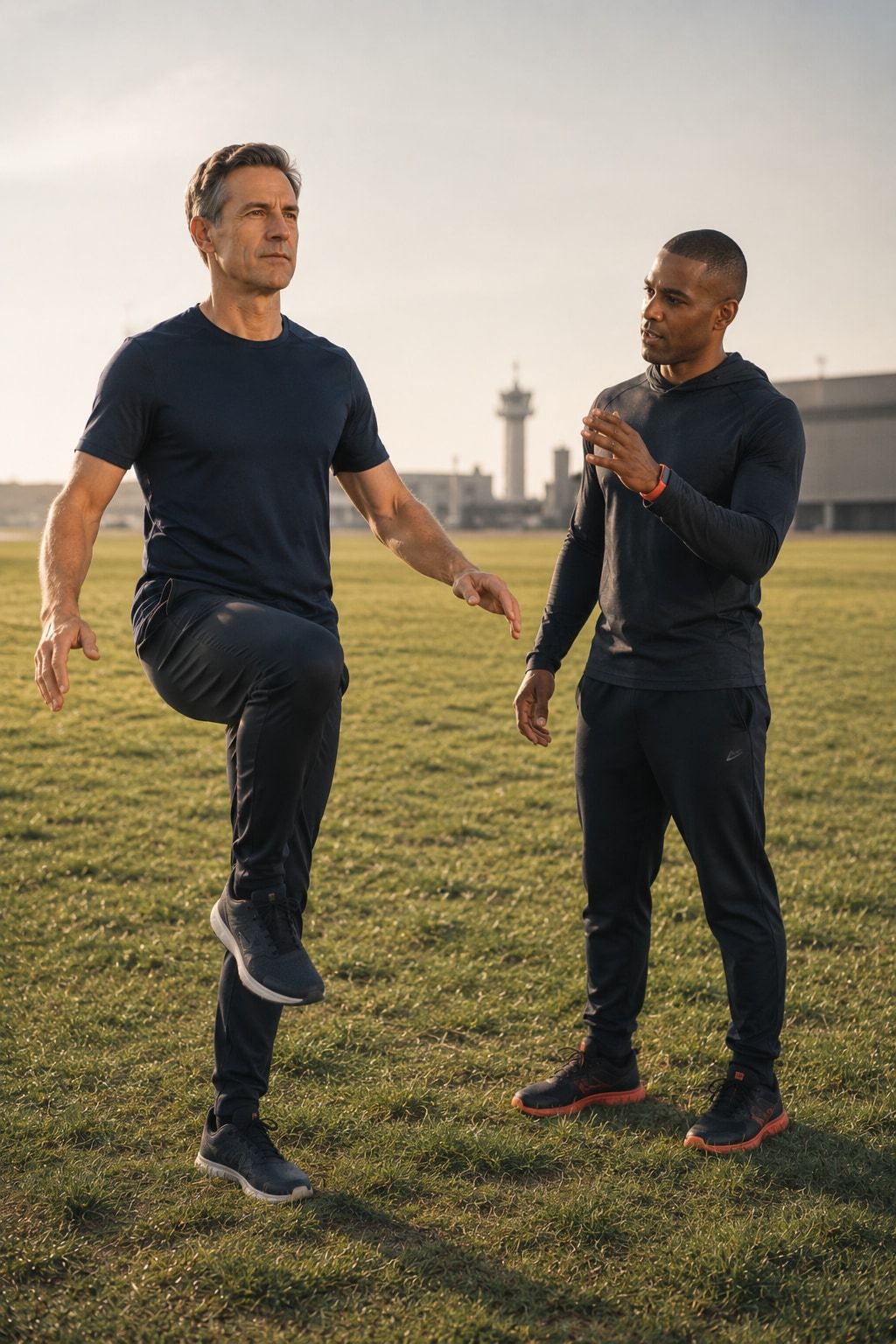
Note: This article does not replace medical advice. Written clearance from the treating physician is strictly required before the first running session after knee surgery. Follow-up training and return-to-sport guidance are not medical treatment and not physiotherapy — they are sports-science-based training guidance after completed medical rehabilitation.
What it Means to Run Again After Knee Surgery
For many recreational athletes, returning to running after knee surgery is one of the most important rehabilitation goals. Running is joint-loading, but at the same time the most direct indicator of “back to full life”. Anyone who manages their first park run after surgery feels it: the knee carries them.
This is also where the biggest risk lies. Biomechanically, running consists of a series of single-leg jumps — each step exposes the operated knee to between 2.5 and 5 times body weight. Anyone who starts too early risks reactive irritation in the implant bed (after TKR), in the reconstructed cruciate ligament or in the cartilage — all avoidable.
A sport-specific return-to-running program is not therapy and not physiotherapy. It is criterion-based training guidance in the gap between completed medical rehabilitation and the first free park run — with measurable prerequisites, gradual loading and a timeline that follows the tests, not the calendar.
For the full pillar overview, see our Follow-Up Training After Knee Surgery article. Those coming from an ACL recovery path can read the cluster article on the ACL pathway as a phase reference once it becomes available in English.
Which Surgery — Which Timeline?
The earliest possible return to running depends directly on the type of surgery. Four typical knee procedures — four different recommendations.
Total Knee Replacement (TKR)
The professional societies (DGSP, DGOU) do not actively recommend jogging after a TKR because the repeated impact can shorten the lifespan of the prosthesis. A systematic review by Faldini et al. (2025, Musculoskeletal Surgery) shows: for motivated former runners a moderate running program is possible under strict prerequisites — no earlier than 6 months after surgery, with written clearance from the surgeon, in shock-absorbing footwear and at reduced frequency (1 to 2× per week). Anyone planning this should not begin without professional guidance.
ACL Reconstruction
Running build-up possible from week 10 to 12 — provided the pre-run tests are met. The time figure is a minimum precondition, not a clearance. Without 80-percent LSI in quadriceps strength and without clean leg-axis control, the knee remains vulnerable to injury.
Partial Meniscus Resection
After a pure partial resection (no repair component) full loading is usually permitted from day 1. Running build-up is often possible from week 6 to 8 — provided the swelling has subsided and the squat can be performed pain-free to 90 degrees of flexion.
Meniscus Repair
This calls for patience: 4 to 6 weeks of partial loading with a flexion limit, then gradual progression. Running build-up no earlier than month 3 to 4, in most clinical protocols rather month 4 to 5 after surgery — depending on the location of the repair, accompanying injuries and written clearance.
Three Pre-Run Tests — Before You Start Running
Before the first walk/jog entry makes sense, three simple tests should be passed. They measure strength, control and load capacity — the three pillars of safe running mechanics. All three can be completed in 15 minutes.
Test 1 — Quadriceps strength (single-leg press or isometric wall sit). On the leg press: single-leg 1-repetition maximum at least 1.25× body weight — and a Limb Symmetry Index between the operated and the healthy leg of at least 80 percent. Without leg press: wall sit at 90° knee flexion — the operated leg must reach at least 80 percent of the hold time of the healthy leg.
Test 2 — Pain-free single-leg squat to 60° of flexion. In standing, arms free, lower slowly, return in control. No knee tipping inward, no pelvic drop, no touch-down of the other foot. 5 clean repetitions in a row — on both sides.
Test 3 — Step-down from a 30 cm step with leg-axis control. Stand on a step, lower slowly until the other foot touches the floor, without the operated knee tipping inward or the stance leg rotating. 10 repetitions without loss of quality.
Anyone who passes all three tests can start the walk/jog program. Anyone who fails one test should continue strength training for another 2 to 3 weeks — the time saved later (avoidance of setbacks) is significantly greater than the delay. At VERTEX this pre-run test battery is part of every initial movement assessment.
The 8-Week Walk/Jog Protocol
Once the pre-run tests are passed, the gradual running build-up begins. The protocol below is oriented on established ACL rehabilitation templates (Mass General Hospital, Faldini protocol for TKA) and is designed for recreational runners with a moderate prior level. Three sessions per week, ideally with at least one rest day between running days.
| Week | Interval per repetition | Repetitions | Total duration | Borg |
|---|---|---|---|---|
| 1 | 1 min jog / 2 min walk | 6× | 18 min | 11–12 |
| 2 | 2 min jog / 2 min walk | 5× | 20 min | 11–12 |
| 3 | 3 min jog / 1 min walk | 5× | 20 min | 12–13 |
| 4 | 5 min jog / 1 min walk | 4× | 24 min | 12–13 |
| 5 | 8 min jog / 1 min walk | 3× | 27 min | 12–13 |
| 6 | 12 min jog / 1 min walk | 2× | 26 min | 13 |
| 7 | 20 min continuous jog | 1× | 20 min | 13 |
| 8 | 25 min continuous jog | 1× | 25 min | 13 |
Three rules apply: first — the running surface stays flat and even (asphalt, well-maintained park paths, no root terrain). Second — if the knee swells or hurts 24 hours after a session, you go back one week in the protocol, not two. Third — only after week 8 do speed variations or gradients follow, and only in 5 to 10 percent progression steps per week.
Where to Train in Berlin
Berlin has some of the best return-to-running locations in Europe — if you know which ones.
Tempelhofer Feld. The gold standard for the first 4 to 6 weeks. Flat asphalt, large outer loop of 6.1 km, abort possible at any point, no root work, well connected to public transit at three U-Bahn entrances. In summer noticeably less crowded after 8 pm.
Volkspark Friedrichshain. Asphalt paths with mild gradients (relevant later), two central sight axes and a station within 5 minutes. Advantage for trainees from Friedrichshain and Prenzlauer Berg — direct door-to-park access.
Treptower Park along the Spree. Long, straight paths with water views, medium-soft surface. Ideal for the continuous running sessions from week 6 onward because the route logic (straight out, straight back) gives a clear sense of pace.
Hasenheide and Lietzenseepark. Both have softer paths than Tempelhof — an advantage in the early phase after cartilage or meniscus surgery (lower impact loading), a disadvantage in the late phase with pace changes (uneven surfaces). Choose by training goal.
What we do not recommend for the first 6 weeks: Grunewald, Spandauer Forst, Müggelsee paths — beautiful forest, but too much root work for a knee in return-to-sport.
Running Technique After Knee Surgery — What Changes
Most recreational runners run at 155 to 165 steps per minute (cadence). An increase of 5 to 10 percent — to 165 to 175 — reduces, according to Lenhart et al. (2014, Medicine & Science in Sports & Exercise), peak patellofemoral loading by about 14 percent and impact loading rate by 11 percent. Exactly what an operated knee needs.
Concretely, this means: shorter steps, more steps. A simple smartphone metronome or a Spotify playlist at 170 BPM (plenty of songs exist) helps to train the frequency. In the first weeks, work explicitly with less speed — higher cadence at the same distance automatically means a shorter step.
Second important adjustment: the foot-strike point. A step that is too long with heel strike well in front of the body’s centre of gravity creates a braking phase with high knee loading. Better: the foot lands close under the pelvis, the hip stays active, the step feels “short and light”. Anyone uncertain here benefits much more from a movement assessment than from video tutorials — compensatory patterns are often invisible in one’s own perception (see “hip strategy” in Popovic et al., 2021).
Third adjustment: leg-axis control. If the knee tips inward under load (knee valgus), loading on the medial meniscus and medial cartilage rises sharply. This often only becomes visible on video — at VERTEX a short smartphone recording from frontal and side perspective is part of the standard running movement assessment.
Building Strength in Parallel with Running
Strength training does not pause during running build-up — it remains the most important protection against reinjury. Studies show clearly: those who complete two strength sessions per week alongside walk/jog build-up have a significantly lower reinjury rate than those who “run first and resume strength later”.
The most important exercises during the walk/jog phase:
- Bulgarian split squat with the operated leg behind — 3 × 8 repetitions, slow, controlled negative phase
- Single-leg Romanian deadlift — 3 × 6 per side, focus on pelvic stability
- Single-leg calf raise — 3 × 12 per side, full range of motion
- Hip thrust bilateral — 3 × 10, glute activation for pelvic stability in the running stance phase
- Plank variations and side plank — 3 × 30 seconds, core stability against pelvic drop
These sessions ideally take place on days without a running session — example: Mon/Wed/Fri walk/jog, Tue/Thu strength, Sat/Sun rest or mobility.
Three Typical Pitfalls
-
Too fast too soon. The most common rehab trap: anyone who tests “let’s see if 20 minutes straight will work” in week 1 risks swelling that throws the program back by 2 to 4 weeks. The walk/jog schedule is not conservative — it is exactly as progressive as the cartilage and the reconstructed ligament can biologically tolerate.
-
Running build-up without parallel strength training. Anyone who stops strength training after medical rehab and “only jogs” loses 15 to 20 percent of the painstakingly built-up quadriceps strength in the first 6 to 8 weeks. This jeopardises leg-axis control on longer runs and measurably raises the reinjury risk.
-
Ignoring pain signals. Slight muscular tension after a run is normal — swelling, warmth or throbbing pain in the knee itself is a clear stop signal. The rule: if the knee is not back to baseline after 24 hours, the next session is cancelled and the program is set back by one week. With recurring swelling over 3 to 5 days the run entry should be aborted and the operating clinic contacted.
Return to Running with VERTEX in Berlin
VERTEX SPORTTHERAPIE offers return-to-running guidance as 1-on-1 support — with studio locations in Mitte, Charlottenburg, Friedrichshain, Prenzlauer Berg and Kreuzberg and outdoor sessions directly at Tempelhofer Feld, in Volkspark Friedrichshain, in Treptower Park and at Lietzensee. Sessions take place in German, English or Spanish — a combination that is rare in Berlin.
A typical 8- to 12-week guidance covers the pre-run test battery, the individualised walk/jog protocol, a running movement assessment (frontal and side perspective via smartphone), parallel strength training and a re-test every 4 weeks. Return-to-running guidance is a self-pay service. Transparent rates are on the Pricing page, and a candid market overview is in the PDF What Does Private Sports Therapy Cost in Berlin?. A 15-minute initial call is free of charge and clarifies whether VERTEX is the right fit for your particular surgery, your medical clearance and your running goal.
What a Follow-Up Training Program Cannot Do
A return-to-sport program is not a therapy and replaces neither out-patient rehab nor medical aftercare. If you experience persistent pain, swelling, restricted range of motion, warmth or redness in the surgical area, or any unclear symptoms, consulting the operating physician is essential.
What a well-structured return-to-sport program does offer: a reliable, criterion-based path from the last rehab appointment to the first free park run — with measurable progress, a step-by-step walk/jog build-up and a realistic timeline that follows your knee, not your calendar.
Frequently Asked Questions
-
When am I allowed to jog again after a total knee replacement?
Most professional societies advise against jogging after a total knee replacement (TKR) because the repeated impact can shorten implant longevity. A 2025 systematic review by Faldini et al. (Musculoskeletal Surgery) does, however, describe a structured protocol for motivated TKR trainees — with clear prerequisites: stable gait without limping, pain-free full loading and written clearance from the operating clinic. Even under ideal conditions, no earlier than 6 months after surgery and at moderate frequency. -
Which strength values should I reach before my first run?
Three thresholds are established in the sports-science literature: quadriceps strength of the operated leg at at least 80 percent of the healthy leg (Limb Symmetry Index, LSI), at least 25 repetitions of bilateral calf raises, and a pain-free single-leg squat to 60 degrees of flexion with good leg-axis control. Anyone who does not reach these three values should not start the walk/jog program yet — patience in this phase significantly reduces the risk of reactive irritation. -
How fast should I run at the beginning?
In the first two to three weeks very slowly — Borg scale 11 to 13, meaning a pace at which you can still speak in full sentences. Concretely, this is around 7 to 9 km/h for most recreational runners. Only after a stable walk/jog build-up (week 6 to 8) do gradual increases in speed follow. Anyone who starts too fast risks swelling, irritation and setbacks — speed work comes much later. -
Which shoes are recommended after knee surgery?
Important are sufficient cushioning in the forefoot and rearfoot, and a well-fitting upper that maintains heel stability. Shoes should be new or have at most 500 km on them — worn-out cushioning increases impact loading on the operated knee. Specific stability shoes are only sensible with documented pronation or leg-axis deviation, and they are ideally chosen after a movement assessment — not on the basis of marketing claims at the sports store. -
Where in Berlin can I best start running again after a knee surgery?
Recommended are flat, even surfaces without roots or curbs. Concretely: Tempelhofer Feld (flat asphalt, 6 km outer loop, easy to abort at any point), Volkspark Friedrichshain (asphalt paths, optional moderate gradients), Treptower Park along the Spree (long, straight surface) and Hasenheide (medium-soft ground, good for gentler stimuli). Forest and heath trails with roots are unsuitable in the first 4 to 6 weeks. -
What should I do if my knee swells after the first run?
Slight irritation with delayed comfort is normal — what matters is recovery within 24 hours. If swelling remains or warmth is added, that is a clear signal to step back: reduce intensity and duration by 30 to 50 percent, take a training break of 3 to 5 days, then restart with shorter intervals. If swelling persists longer or is painful, consulting the operating clinic is essential. -
Should I pause strength training while doing walk/jog?
On the contrary — strength training is particularly important during the walk/jog build-up. Studies show that continuing quadriceps, glute and calf training in parallel with starting to run reduces reinjury rates and stabilises running mechanics. Sensible are 2 strength sessions per week with a focus on single-leg exercises (Bulgarian split squat, single-leg Romanian deadlift, single-leg calf raise), ideally on days without a running session. -
Do health insurers cover the return-to-running program?
Return-to-sport as 1-on-1 personal training is a self-pay service — statutory health insurers do not typically cover it. Rehabilitation sport under § 64 SGB IX through an approved club only covers group settings and ends at basic load capacity, not at sport-specific running build-up. Some private health insurers and government allowance schemes reimburse personal training with a rehabilitation focus on a pro-rata basis — the concrete conditions should be clarified with your specific plan before training begins.
This service in detail
Return to Sport — structured training guidance with Julio
If you would like to apply this knowledge in your daily life — Julio guides you 1-on-1 through every phase. Initial call free of charge, available in DE / EN / ES.
Scientific Sources
This content is based on the following guidelines, systematic reviews and specialist publications:
- 1. Returning to running after total knee arthroplasty: a systematic review and a novel multimodal protocol Musculoskeletal Surgery (Faldini et al.), 2025
- 2. S1 Guideline Anterior Cruciate Ligament Rupture (DGOU) AWMF / DGOU, 2023
- 3. Return to Sport Following Anterior Cruciate Ligament Reconstruction: A Scoping Review of Criteria Determining Return-to-Sport Readiness Journal of Orthopaedic & Sports Physical Therapy (PubMed), 2024
- 4. Limb Symmetry Indexes Can Overestimate Knee Function After Anterior Cruciate Ligament Injury Journal of Orthopaedic & Sports Physical Therapy, 2017
- 5. Increasing Running Step Rate Reduces Patellofemoral Joint Forces Medicine & Science in Sports & Exercise (Lenhart et al.), 2014
- 6. The Influence of Running Cadence on Biomechanics and Injury Prevention: A Systematic Review Cureus / PMC, 2025
- 7. 3D Movement Analysis: Running After Knee Arthroscopy Sportärztezeitung (Popovic, Krahl, Plachel), 2021
- 8. Return to Sport after Endoprosthetics Sportärztezeitung, 2023
About the author
Julio Abad Veria
Sports Therapist · Sports Scientist
Julio completed a five-year university degree in Sports Science in Cuba, officially recognised in Germany as a Sportwissenschaftler by the Central Office for Foreign Education (ZAB). For 14 years he has worked in in-patient and out-patient rehabilitation centres in Berlin — today with a focus on 1-on-1 follow-up training after completed medical care.
Continuing education relevant to this topic:
- Physiotherapy on equipment — clinical pictures
- Movement therapy for oncological conditions
- Aqua Trainer Basic
Related articles
-
Follow-up Training Program
Training After Knee Surgery: the Follow-Up Program for the First 12 Weeks
Structured rebuilding of knee function after completed medical care: 12-week follow-up training for TKR, ACL and meniscus, with a sport-by-sport return plan.
-
Follow-up Training Program
Follow-Up Training After ACL Surgery: the 9-Month Plan Back to Sport
Structured training phases after ACL reconstruction (patellar tendon, hamstring, quadriceps tendon): from crutch weaning to return-to-sport — criteria, tests, realistic timeline.
- Universitäts-Diplom anerkannt Anabin / ZAB Zeugnisbewertung
- 9 Jahre in Berlin
- Aqua Trainer Basic Fortbildungs-Zertifikat
- KG-am-Gerät-Fortbildung Fortbildungs-Zertifikat
- Onkologische Bewegungstherapie-Fortbildung Fortbildungs-Zertifikat
Schwestermarke
Sie suchen ein Programm für Ihr Unternehmen, Pflegeheim oder Ihre Praxis?
MOVETICA — die Schwestermarke für B2B-Bewegungs- und Gesundheitsprogramme. Reha, Firmenfitness, Seniorenbewegung, Prävention, Aquatherapie.
MOVETICA ist eine zweite Marke desselben Inhabers Julio Abad Veria. Beide Marken bedienen unterschiedliche Zielgruppen und Angebote: VERTEX richtet sich an private Endkunden (B2C), MOVETICA an Organisationen (B2B).