Follow-up Training Program · 12 min read
Follow-Up Training After a Total Knee Replacement: Strength Training, Sports and Fall Prevention
Structured training program after a total knee replacement: phases, exercises, Borg/ROM/LSI metrics, a 14-sport return table and fall prevention for seniors 60+.
- Published:
- Author:
- Julio Abad Veria, Sports Therapist · Sports Scientist
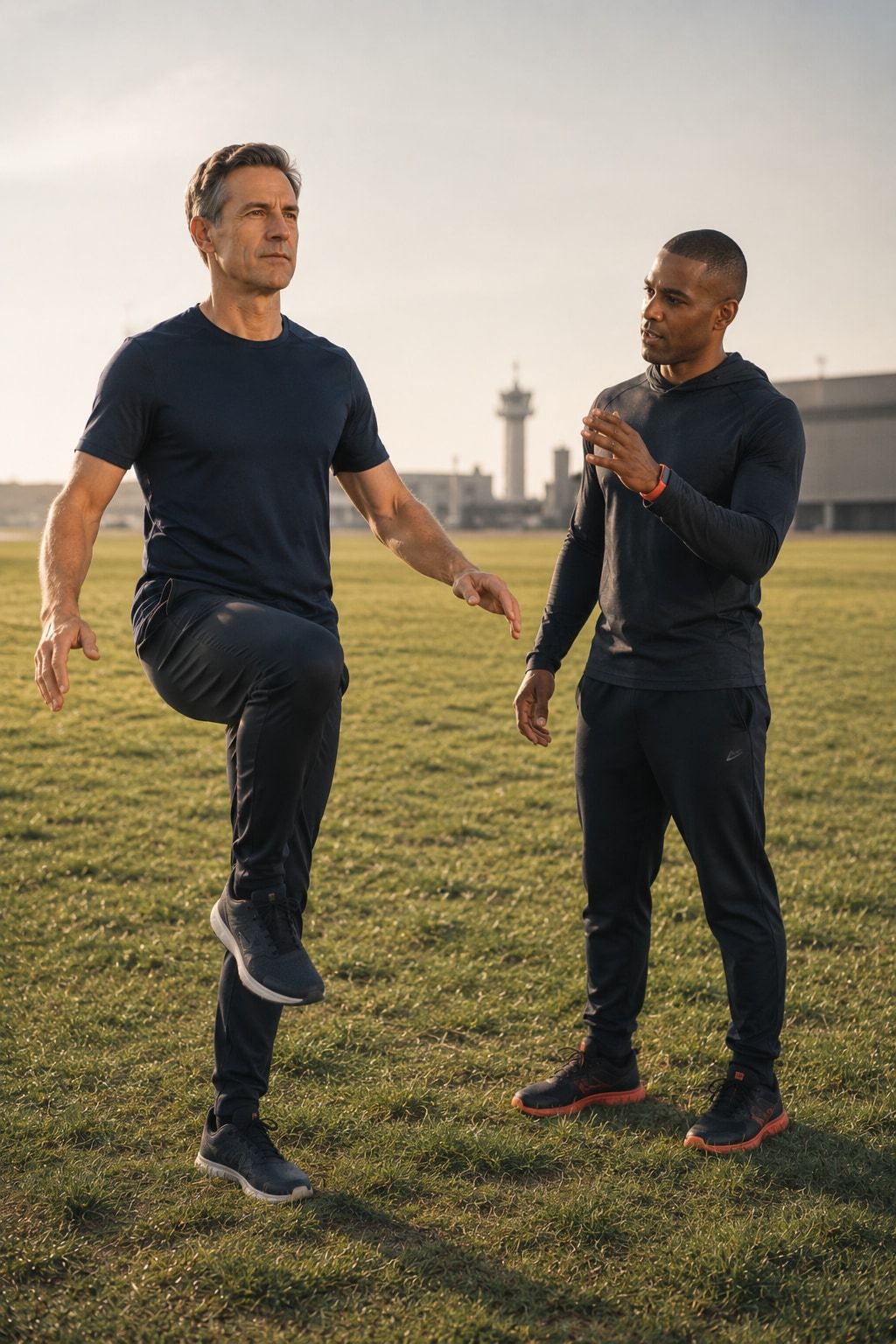
Note: This article does not replace medical advice. Written clearance from the treating physician is strictly required before any training is started after a total knee replacement (TKR). A follow-up training program is not a medical treatment and not physiotherapy — it is sports-science-based training guidance after completed medical rehabilitation.
What Follow-Up Training After a Total Knee Replacement Really Is
A total knee replacement (TKR) is, with more than 190,000 procedures per year, one of the most frequent orthopaedic operations in Germany — and for most patients the end of a long history of pain. The surgery itself is well standardised; the actual outcome, however, is built in the 12 to 24 weeks after rehabilitation. How much strength the operated leg ultimately reaches, how stable the gait pattern remains and how big the fall risk turns out to be does not depend on the operating room, but on the training routine afterwards.
A follow-up training program closes this gap. It does not replace physiotherapy, is not a medical treatment and not pain therapy. It is sports-science-based guidance built on medical clearance — with clear loading steps, regular re-testing and a sport perspective that fits real life.
For an overview of all four knee surgery types, see the pillar article on training after knee surgery. This article focuses on the TKR pathway — a strongly senior-leaning patient group where fall prevention and implant care must be balanced carefully.
Which Implant Type Was Fitted? Three Pathways
Which endoprosthesis design the surgeon used is recorded in the surgical report and visibly shapes the first 8 to 12 weeks of follow-up training.
Bicondylar Standard TKR (Surface Replacement)
The standard procedure in Germany. It replaces the joint surfaces of the femur and tibia, usually with cement fixation. Loading is typically progressed from day 1 through week 2, with full loading mostly cleared after 4 to 6 weeks. Range of motion (ROM) is the central lever here: without active flexion above 110° in the first 12 weeks, many everyday tasks remain permanently more difficult.
Unicondylar Partial Knee Replacement (Uni-Knee)
If only the inner or outer compartment is worn, a smaller partial knee replacement can be fitted. The advantage: faster rehab, significantly greater possible range of motion (often up to 130°) and better gait mechanics. Follow-up training can start earlier and more intensively — typically as early as week 4 to 6, with brisk progression into phase 2. A prerequisite is an intact ligament structure and healthy cartilage in the other compartments; this procedure is not suitable for everyone.
Standard TKR with Patellar Resurfacing
The back of the kneecap is additionally replaced with a small polyethylene button depending on the degree of wear. Training-relevant is this variant mainly for phase 1: patellar mobilisation, pain-free quadriceps activation and the careful weaning of typical anterior knee pain that can occur in the first weeks after this surgical detail. Deep squats above 90° belong only to later phases and only under clinical freedom from symptoms.
The training plan and the load progression must match the implant design — that is standard knowledge in any experienced sports therapy. A generic “knee training” without knowing the design is not sufficient in the follow-up phase.
Rehabilitation Phases at a Glance
A typical follow-up program after a TKR is organised in five phases, the first two of which take place during medical rehabilitation:
| Phase | Time frame (guideline) | Content | Responsibility |
|---|---|---|---|
| 0 | Day of surgery to week 2 | Wound healing, mobilisation, CPM splint, partial loading on crutches | Clinic / surgeon |
| 1 | Week 2–6 | Full extension, flexion towards 90°, quadriceps activation, gait training | Medical rehab (AHB) |
| 2 | Week 6–12 | Full loading, bilateral strength training, ergometer, balance | Follow-up training |
| 3 | Week 12–24 | Single-leg strength, step progression, sport-specific approach | Follow-up training |
| 4 | from week 24 | Return to sport after re-test, ongoing conditioning | Follow-up training |
VERTEX typically comes in at the transition from phase 1 to phase 2 — that is, about week 6 to 8 after surgery, after completed medical AHB and with written clearance.
Phase 1 (Weeks 2–6): Movement Security and Gait Training
In this phase the main responsibility lies with the medical rehab (AHB) and physiotherapy. Follow-up training can accompany the phase — usually through check-in visits and homework plans — but not replace it.
- Isometric quadriceps activation in sitting and lying positions (hold 5–10 seconds, 3 sets of 10)
- Guided squat at the wall or table (depth limited to the pain-free range, typically 30–60°)
- Balance exercises in two-leg stance on a soft mat
- Gait re-education without limping — conscious step length, foot roll, pelvic stability
What does not yet take place in phase 1: single-leg strength, free squats with load, any form of jumping or impact loading.
Phase 2 (Weeks 6–12): Full Loading, Bilateral Strength Training Begins
As soon as full loading has been cleared and the gait is possible without visible limping, structured strength training begins. The goal is not maximum strength, but rebuilding a load-capable movement foundation.
- Bilateral squat with body weight, then with a light goblet squat load (kettlebell), depth progressively increased to 90°
- Leg press with submaximal load (Borg 11–13), knee angle initially limited to 90°
- Hip-hinge pattern (Romanian deadlift with a light barbell) — crucial for later stair and hiking mechanics
- Ergometer endurance 20–30 min, cadence 70–90, low resistance (Borg 11–12)
- Core stabilisation and hip abductors (side plank, side step with mini-band) — direct fall prophylaxis
Water-based training is a particularly grateful tool here — the Aqua Movement Training line allows strength and mobility stimuli with strongly reduced joint pressure.
Phase 3 (Weeks 12–24): Single-Leg Strength and Step Progression
This phase decides whether the operated leg becomes permanently equally load-capable — or whether the healthy leg compensates permanently (with hip and back consequences).
- Bulgarian split squat with the operated leg in front, later behind — progressively with added weight (3 × 8–10, Borg 13–15)
- Single-leg Romanian deadlift for the posterior chain
- Step-up with progressive height (15 → 20 → 25 → 30 cm) and gradually added weight
- Single-leg stand balances with wall safety, later free (Y-Balance test is the measurement format here)
- Sport-specific approach: for swimmers, pain-free kick tests at the pool edge; for cyclists, gradient simulation on the ergometer; for hikers, progressive stair distances
Plyometric jumps are not a standard exercise after a total knee replacement — the impact loading acts directly on the implant-bone interface. Exceptions are very ambitious courses after a unicondylar partial knee replacement, and only after medical consultation.
Steering Load Correctly: Borg Scale, ROM Targets, LSI
Three sports-science tools make the difference between “training somehow” and “demonstrable progress”:
Borg scale 6–20 for training intensity. A subjective load scale that in follow-up training prescribes endurance sessions at values between 11 (“light”) and 13 (“somewhat hard”), and strength sessions at 13 to 15. This protects the sensitive implant bed from overload and makes load comparable across weeks — without a heart-rate monitor.
Range of Motion (ROM) as a rehab target. After a standard total knee replacement, an active flexion of about 90° at 2 weeks, 110° at 6 weeks and at least 120° at 12 weeks is the orientation (AWMF S2k 187-004). If the ROM is not reached, the medical side must react before any further training — follow-up training cannot close this gap and must not paper over it.
Limb Symmetry Index (LSI) as a function metric. The LSI compares strength performance of the operated leg with that of the healthy leg (typically measured via leg-press maximum, single-leg sit-to-stand or isokinetic quadriceps measurement). For TKR patients an LSI of at least 80 % after 6 months is a realistic minimum target — lower means increased fall and asymmetry risk, higher is a bonus.
At VERTEX these three metrics are recorded at every movement assessment — as a baseline at the start, and as a progress measurement every 6 weeks.
When May I Do What Again? — Return by Sport
The figures below follow the guidance of the German Society of Sports Medicine and Prevention (DGSP) and assume an uncomplicated course after a standard TKR. Binding is always the medical clearance.
| Sport | Earliest re-entry | Recommendation | Note |
|---|---|---|---|
| Aqua jogging | from week 6 | recommended | Very joint-friendly, ideal in phase 2 |
| Swimming (crawl / backstroke) | from week 6–8 | recommended | Breaststroke kick loads the medial ligament strongly — avoid |
| Cycling (stationary, then flat outdoors) | from week 6–8 | recommended | Saddle high enough, low cadence |
| Walking on flat ground | from week 8 | recommended | Distance progressive, good footwear |
| Hiking (flat) | from week 8–10 | recommended | Use poles, no steep downhill |
| Nordic walking | from week 10–12 | recommended | Active pole work relieves the knee |
| Cross-country skiing (classic) | from month 4–6 | recommended | Avoid skating style |
| Dancing (partner, no spins) | from month 4 | recommended | Avoid jumps and rapid turns |
| Golf (with cart, not walking) | from month 4–6 | conditional | Swing rotation strongly loads the knee |
| Tennis doubles | from month 6–9 | conditional | Singles only with prior experience + individual clearance |
| Alpine skiing (carefully, prepared slopes) | from month 9–12 | conditional | Only with prior experience, no deep snow, no moguls |
| Jogging | not recommended | discouraged | Impact load 3–4× body weight per step |
| Squash, football, handball, basketball, volleyball | not recommended | discouraged | High torques + contact = high revision risk |
| Martial arts with ground contact, kicks | not recommended | discouraged | Not compatible with implant fixation |
The important nuance — and a frequently overlooked point: a total knee replacement is not a “sport ban”, it is sport steering. Anyone who moves 4 to 6 times per week in low- and moderate-impact sports demonstrably lives longer, has higher quality of life and a lower fall risk than TKR patients without sport. Inactivity is a disease amplifier here, not protection.
Three Typical Pitfalls
- Too much load too early. Putting the leg press in week 4 back at the pre-surgery training weight risks an irritation around the implant bed and a rehab setback. The first 12 weeks are a build-up phase, not a test phase — Borg 11–15, no maximum.
- Neglecting hip and core. Fall risk after a TKR rarely arises at the knee itself, but in the lateral pelvic stability (gluteus medius) and in trunk control during direction changes. Follow-up training that only watches the knee misses the actual lever.
- Not taking fear of falling seriously. Studies show that “fear of falling” after a TKR is an independent risk factor for real falls — avoidance behaviour reinforces the movement scarcity, which in turn leads to falls. In follow-up training, graded everyday challenges (curbs, uneven paths, boarding a bus under time pressure) belong consciously on the plan. A movement assessment and the fall prevention program for seniors are the obvious bridge here.
Follow-Up Training After a Total Knee Replacement in Berlin
VERTEX SPORTTHERAPIE offers 1-on-1 follow-up training after a total knee replacement in several Berlin studios — and, where transit links allow, in clients’ homes too. With studio locations in Mitte, Charlottenburg, Friedrichshain, Prenzlauer Berg and Kreuzberg, VERTEX is reachable within 30 minutes by public transport for most self-paying clients. Sessions are available in German, English or Spanish — a rare combination in Berlin and a noticeable difference for clients with a different first language.
The overlap with our senior movement training line is large: 70 % of all TKR patients in Germany are over 65 years old, and many bring further topics (hip, back, balance). Follow-up training after a TKR is accordingly not planned at VERTEX as an isolated knee program, but embedded in an overall concept of strength, balance and fall prevention — with clear implant care in the sport profile.
Follow-up training is a self-pay service. Transparent rates are on the Pricing page, and a candid market overview is in the PDF What Does Private Sports Therapy Cost in Berlin?. A 15-minute initial call is free of charge and clarifies whether VERTEX is the right fit for your implant design, your medical clearance and your desired sport profile.
What a Follow-Up Training Program Cannot Do
A follow-up training program is not a therapy and replaces neither out-patient rehab nor medical aftercare. If you experience persistent pain, swelling, restricted range of motion, warmth or redness in the surgical area, or a sudden feeling of instability, consultation with the operating physician is essential — this applies especially in the first year after surgery, in which late complications occur most frequently.
What a well-structured follow-up training program does offer: a reliable path from medical care to everyday life with an artificial knee joint — with measurable progress, a realistic sport profile and fall prevention that makes the next surgery less likely.
Frequently Asked Questions
-
When am I allowed to start strength training after a total knee replacement?
As a rule, structured strength training begins after the completed medical rehabilitation — typically 6 to 8 weeks after surgery. A prerequisite is the written clearance from the treating physician plus a pain-free and swelling-free full loading in everyday life. The entry point is submaximal loads (Borg 11–13) on the leg press and in guided squats, not free maximum-strength exercises. -
How long do I need crutches after a total knee replacement?
The partial-loading phase with forearm crutches typically lasts 2 to 6 weeks after a standard total knee replacement. The crutch weaning is the task of the medical rehabilitation (AHB) and physiotherapy — follow-up training only starts once full loading has been cleared and a gait without visible limping is possible. Anyone still showing an asymmetric gait pattern in the follow-up phase begins with gait re-education and pelvic stability before strength stimuli are set. -
Which sports are allowed after a total knee replacement — and which are not?
Recommended are low-impact sports: swimming (avoid breaststroke), aqua jogging, cycling on flat ground, walking, hiking, dancing without spins, classic cross-country skiing and golf with a cart. Conditionally recommended are tennis doubles and alpine skiing — only with prior experience and individual clearance. Generally discouraged are singles tennis, squash, football, handball, basketball, volleyball, jogging and contact sports. The final clearance for each sport remains a medical decision. -
When am I allowed to jog again after a total knee replacement?
Jogging is mostly not recommended after a total knee replacement. The repeated impact load (three to four times body weight per step) acts on the implant-bone interface and can shorten the lifespan of the prosthesis. Anyone with a strong urge to run should clarify with the operating clinic whether a limited, very controlled running volume on soft ground is possible — as a standard recommendation it does not apply. -
How long does a total knee replacement last — and how does sport affect its longevity?
Modern cemented total knee endoprostheses last 15 to 20 years or longer in registry data; in younger, active patients a revision surgery is more likely earlier. Impact-loading sports accelerate the polyethylene wear of the bearing and can reduce implant lifespan. Low-impact sport has no measurable negative effect according to current data; the load is explicitly desired because it preserves bone, muscle and balance. -
What is the difference between a standard TKR, a partial knee replacement and patellar resurfacing?
A bicondylar standard total knee replacement replaces all three joint compartments (inner, outer, patellar bearing). A partial knee replacement (unicondylar prosthesis) replaces only a one-sided joint wear and allows faster load progression and greater range of motion. Patellar resurfacing is optionally fitted to the standard TKR if the back of the kneecap is heavily worn — it mainly influences the anterior knee pain pattern during follow-up training. -
How high is the fall risk after a total knee replacement — and what helps against it?
Recent studies report fall rates of around 17 percent in the first 6 months after a total knee replacement; in patients over 75 the risk is 1.6 times higher than in those under 55. Effective countermeasures are early balance and pelvic stabilisation exercises, single-leg stand progression on unstable surfaces and targeted hip-abductor strength. Fear of falling is an independent risk factor and belongs explicitly on the follow-up training plan — addressed through graded everyday loads rather than avoidance behaviour. -
Do health insurers cover follow-up training after a total knee replacement?
Rehabilitation sport under § 64 SGB IX is, with a medical prescription, available as a benefit-in-kind through an approved club, but covers only group settings. Privately delivered 1-on-1 follow-up training is a self-pay service; some private health insurers and government allowance schemes refund personal training with a rehabilitation focus on a pro-rata basis — clarifying this with your specific plan before training begins is advisable. Conditions are on the pricing page.
This service in detail
Follow-up Training Program — structured training guidance with Julio
If you would like to apply this knowledge in your daily life — Julio guides you 1-on-1 through every phase. Initial call free of charge, available in DE / EN / ES.
Scientific Sources
This content is based on the following guidelines, systematic reviews and specialist publications:
- 1. S2k Guideline Indication for Total Knee Endoprosthesis (EKIT-Knee) 187-004 AWMF / DGOU / DGOOC, 2023
- 2. Endoprostheses and Sport — Position Statement German Journal of Sports Medicine (DGSP), 2017
- 3. Sport after Hip and Knee Endoprosthesis: What Do We Allow? Universimed Orthopaedics & Traumatology, 2024
- 4. Return to Sport after Endoprosthetics Sportärztezeitung, 2023
- 5. Sport Load and Load Capacity after Endoprosthetic Joint Replacement German Journal of Sports Medicine (DGSP), 2009
- 6. Effectiveness of Physiotherapy Exercise Following Total Knee Replacement: Systematic Review and Meta-Analysis BMC Musculoskeletal Disorders / PMC, 2015
- 7. Continuous Passive Motion after Knee Replacement Surgery (Cochrane Review CD004260) Cochrane Database of Systematic Reviews, 2014
- 8. Risk Factors of Post-Discharge Falls in Patients Undergoing Total Knee Arthroplasty: An Integrative Review PMC / International Journal of Orthopaedic and Trauma Nursing, 2024
About the author
Julio Abad Veria
Sports Therapist · Sports Scientist
Julio completed a five-year university degree in Sports Science in Cuba, officially recognised in Germany as a Sportwissenschaftler by the Central Office for Foreign Education (ZAB). For 14 years he has worked in in-patient and out-patient rehabilitation centres in Berlin — today with a focus on 1-on-1 follow-up training after completed medical care.
Continuing education relevant to this topic:
- Physiotherapy on equipment — clinical pictures
- Movement therapy for oncological conditions
- Aqua Trainer Basic
Related articles
-
Follow-up Training Program
Training After Knee Surgery: the Follow-Up Program for the First 12 Weeks
Structured rebuilding of knee function after completed medical care: 12-week follow-up training for TKR, ACL and meniscus, with a sport-by-sport return plan.
-
Follow-up Training Program
Follow-Up Training After ACL Surgery: the 9-Month Plan Back to Sport
Structured training phases after ACL reconstruction (patellar tendon, hamstring, quadriceps tendon): from crutch weaning to return-to-sport — criteria, tests, realistic timeline.
- Universitäts-Diplom anerkannt Anabin / ZAB Zeugnisbewertung
- 9 Jahre in Berlin
- Aqua Trainer Basic Fortbildungs-Zertifikat
- KG-am-Gerät-Fortbildung Fortbildungs-Zertifikat
- Onkologische Bewegungstherapie-Fortbildung Fortbildungs-Zertifikat
Schwestermarke
Sie suchen ein Programm für Ihr Unternehmen, Pflegeheim oder Ihre Praxis?
MOVETICA — die Schwestermarke für B2B-Bewegungs- und Gesundheitsprogramme. Reha, Firmenfitness, Seniorenbewegung, Prävention, Aquatherapie.
MOVETICA ist eine zweite Marke desselben Inhabers Julio Abad Veria. Beide Marken bedienen unterschiedliche Zielgruppen und Angebote: VERTEX richtet sich an private Endkunden (B2C), MOVETICA an Organisationen (B2B).