Follow-up Training Program · 12 min read
Follow-Up Training After Knee Cartilage Surgery: Microfracture, MACI and OATS Compared
The course after microfracture, MACI and OATS: why cartilage procedures need the longest recovery period of all knee surgeries and which training stimuli are allowed when.
- Published:
- Author:
- Julio Abad Veria, Sports Therapist · Sports Scientist
Note: This article does not replace medical advice. Written clearance from the treating physician is strictly required before any training is started after knee cartilage surgery — particularly so, since cartilage procedures count among the most sensitive orthopaedic knee surgeries. A follow-up training program is not a medical treatment and not physiotherapy — it is sports-science-based training guidance after completed medical rehabilitation.
What Follow-Up Training After Cartilage Surgery Really Is
Cartilage procedures of the knee are unique in one respect: they require by far the longest period of caution and rebuilding of any orthopaedic knee surgery. While after a meniscus resection the first sport steps are possible at 4 to 6 weeks, and after an ACL reconstruction pivoting sports may be considered at 9 to 12 months, for cartilage surgery one year is the lower bound and stop-and-go sports often only re-enter the picture from month 18.
The reason lies in cartilage biology itself. Cartilage has no direct blood supply, regenerates extremely slowly, and is biologically an open wound inside the joint for the first weeks after a repair procedure. Anyone giving impact load too early irreversibly damages the fresh repair tissue — and undoes the surgery in the process. A structured follow-up training program in this phase is therefore not an acceleration — it is a controlled, very slow dosing of stimuli according to the operating clinic’s specifications.
This article focuses on the cartilage path. For an overview across all four knee surgery types (TKR, ACL, meniscus, cartilage) see the pillar article on training after knee surgery.
Three Procedures, Three Training Paths
Three surgical standard procedures are used in Germany today, with very different biological mechanisms — and therefore different follow-up training.
Microfracture
The oldest and simplest procedure: after cleaning the defect, small holes are drilled into the underlying bone with a fine pick, so that bone-marrow stem cells bleed into the defect and form a fibrocartilage repair tissue. Advantages: single-stage, low cost, broadly available. Disadvantages: the fibrocartilage is mechanically considerably less durable than healthy hyaline cartilage. International reviews report a return-to-sport rate of around 75 to 77 percent and a mean return at about 8 to 9 months — with limited long-term stability especially for defects larger than 2.5 cm².
MACI / MACT (Matrix-Induced Autologous Chondrocyte Implantation)
A two-stage procedure: first, cartilage cells are harvested from a low-load knee region, expanded in the lab over 4 to 6 weeks and seeded onto a collagen matrix. This is implanted into the defect in a second surgery. Healing takes considerably longer, but the quality of the resulting cartilage is closer to the original hyaline tissue. Return-to-sport rate around 84 percent, mean return at 11 to 16 months. In Germany MACI is now a regular statutory health insurance benefit for defects from roughly 2.5 cm² upwards.
OATS (Osteochondral Autograft Transplantation)
A cylindrical cartilage-bone block is harvested from a low-load knee region and transferred into the defect. Advantages: single-stage, immediately load-bearing hyaline tissue. Disadvantages: suitable only for smaller defects (typically below 2 cm²), because new damage can arise at the donor site. Return-to-sport rate around 77 percent, return at 9 to 10 months. For ambitious athletes with small defects, often the procedure of choice because the transplanted tissue carries mechanical load from the start.
Which procedure the surgeon chose is in the operative report — and co-defines when and at what intensity follow-up training may even begin.
Rehabilitation Phases at a Glance
A typical cartilage follow-up program is organised in five phases — one more than after ACL or meniscus surgery, because cartilage biology requires its own protective windows:
| Phase | Time frame (guideline) | Content | Responsibility |
|---|---|---|---|
| 0 | Day of surgery to week 6 | Wound healing, CPM machine, 10–20 kg partial weight-bearing on crutches | Clinic / surgeon |
| 1 | Week 6–12 | Transition to full weight-bearing, isometric quadriceps work, water mobilisation | Follow-up training |
| 2 | Week 12–26 | Guided strength and coordination build-up, stationary bike, first land exercises with load | Follow-up training |
| 3 | from month 6 | Sport-specific preparation, first cautious impact stimuli | Follow-up training |
| 4 | from month 12 (MACI: 18) | Return-to-sport tests, controlled pivot-sport entry | Follow-up training |
Exact week numbers depend on the procedure, defect size, defect location (femoral condyle vs. retropatellar) and medical orders. A retropatellar defect, for example, often comes with an extension-limiting brace for 8 weeks in many clinic schemes — follow-up training then starts a further 2 to 4 weeks later than for femoral defects.
VERTEX typically joins at the transition from phase 0 to phase 1 — after full weight-bearing clearance and with written medical approval.
Phase 1 (Weeks 6–12): Transition to Full Loading, Water First
In this phase the leg is moved from partial loading on crutches to full loading in everyday life. The goal is not muscle build-up but the restoration of a safe gait and very cautious activation of the atrophied thigh musculature.
- Isometric quadriceps activation in sitting and lying positions (hold times 5–10 seconds, 3 sets) — the most important stimulus of this phase
- Gait re-education without limping, with conscious foot roll and pelvic stability
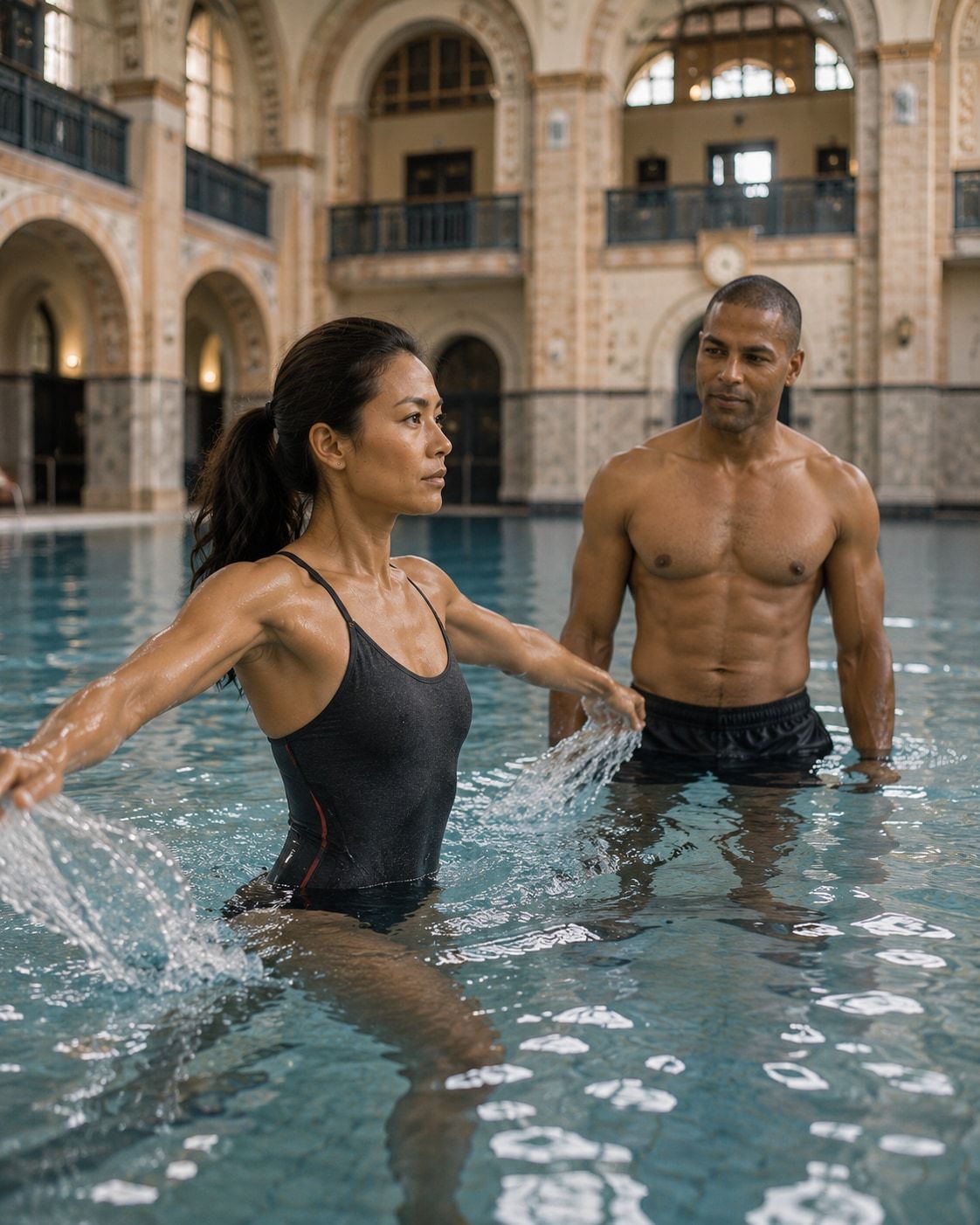
- Water familiarisation from medical clearance for wound healing: first standing in hip-deep water, then weight shifts, then aqua walking
- Guided wall squats or with a TRX strap, depth strictly limited to the pain-free range (typically 0–45° of flexion)
- No strength training with external load, no unsupported single-leg stance, no stair climbing with added weight
Water-based training plays a special role in this phase — see our Aqua Movement Training service line, which serves as the joint-friendly strength and mobility platform in early cartilage rehab.
Phase 2 (Weeks 12–26): Building Strength and Coordination — No Plyometrics
Once pain-free full loading is achieved, the actual strength build-up begins — very gradually and with a clear red line: no plyometric stimuli of any kind, no impact loading, no rotational loading under weight.
- Two-leg squats with body weight, then with goblet squat load (3–5 kg, slowly progressed), depth progressively to 90°
- Leg press with submaximal load (Borg 11–13), within the pain-free range of motion
- Hip-hinge pattern (light Romanian deadlift with a barbell) for the posterior chain and pelvic stability
- Step-up at low step height (15 → 20 cm), no additional load in the first 4 weeks of this phase
- Stationary-bike endurance 20–30 min, cadence 70–90, low resistance
- Proprioceptive stimuli in two-leg stance on a balance pad, progressing to controlled single-leg stance with wall safety
Sports in this phase: cycling (stationary first, then flat outdoors), swimming (avoid breaststroke — the kick loads the medial ligament and additionally irritates patellofemoral defects), aqua jogging, Nordic walking. Jogging is off-limits in phase 2, as are squash, singles tennis and all team sports with a jump or change-of-direction component.
Phase 3 (from Month 6): First Cautious Impact Stimuli
Only from month 6 — and only after a re-test demonstrating pain-free loading, full active extension, at least 130° flexion and quadriceps symmetry in the single-leg squat — may the first impact stimuli appear.
- Walk/jog protocol very gently, similar to after ACL surgery — start with 1 min jogging / 2 min walking, slow progression over 6–8 weeks
- Low-impact plyometrics: pogo hops on a soft surface (mat), tap drills, then first flat box step-downs with controlled landings (“soft roll-down, no slapping”)
- Bulgarian split squat with the operated leg behind, light additional load
- Single-leg Romanian deadlift for the posterior chain and pelvic stability
- Sport-specific preparation depending on the target sport (skiers: lateral stability at low height; hikers: progressive incline stimuli; dancers: controlled rotations without jumping)
Important: a re-test in month 6 is mandatory, not optional. Moving into the impact-stimulus phase without an objective criteria check is the largest avoidable risk in the entire cartilage rehabilitation.
Phase 4 (from Month 12, MACI from Month 18): Return-to-Sport — Criteria-Based
Pivoting sports — football, handball, basketball, alpine skiing, squash — remain particularly sensitive after cartilage procedures. International recommendations envisage a return to stop-and-go sports at the earliest from month 12 (microfracture, OATS) or month 18 (MACI) — and only then after a passed test battery:
- Hop-test battery (Limb Symmetry Index, LSI ≥ 90 %): single-leg hop, triple hop, cross-over hop, 6-metre timed hop
- Isokinetic strength measurement for quadriceps and hamstrings — LSI ≥ 90 %
- Y-balance test for dynamic leg-axis control
- Pain-free movement across all load levels, including jump landings
For pivoting sports, supplement with sport-specific drills — first two-legged and without opponents, later controlled in team training, finally in competition. For ongoing competition load, do an honest risk weighing: microfracture patients, in particular, return durably to their sport in only about 75 percent of cases according to studies; further surgical procedures are not rare in the mid-term.
Why Patience Here Is Not Just Caution but Biology
Cartilage matures slowly — and in four biological phases that a good follow-up training program knows and respects (rehabilitation scheme according to ATOS Kliniken and the international cartilage rehab literature):
- Proliferation phase (weeks 1–6): Tissue ingrowth and first cell division. Shear forces and impact stimuli destroy the young tissue.
- Transformation phase (weeks 7–12): Collagen build-up and matrix formation. Loading increases very slowly; load-free movement is the central rehab stimulus.
- Remodelling phase (months 4–6): First mechanical stability, strength build-up possible — but still no impact stimuli.
- Maturation phase (month 7 to year 3): Long-term consolidation. The tissue becomes denser in the first 12 months and, gradually thereafter, more mechanically resilient.
Each of these phases has its own load window. Anyone running in week 8 damages the repair tissue during its most vulnerable phase. Anyone doing plyometrics in month 4 risks delamination of the repair. Patience here is not weakness — it is the only strategy that works with the biology rather than against it.
Three Typical Pitfalls
- Early plyometrics. The most common avoidable error in cartilage rehab. Practising jumps from month 3 or 4 “because the knee feels fine” damages the repair tissue in its most vulnerable maturation window. Plyometrics have no place in the whole of phase 2.
- Weight reduction neglected. Every additional kilo of body weight generates three to five times that in pressure on the knee during everyday loading. Anyone returning after cartilage surgery with a BMI above 30 — without an accompanying nutrition and endurance concept — has a markedly elevated risk of repair-tissue failure. A movement consultation integrates weight management as an equal rehab topic.
- Missing ROM re-tests. Cartilage repairs can develop range-of-motion restrictions in the first 12 weeks — especially retropatellar. Without a documented ROM re-test by week 12 at the latest, you risk a fixed stiffness that is hard to resolve later. ROM measurement is standard in every movement assessment and should be repeated every 6 to 8 weeks — a tool for self-checks between sessions is our Mobility & Strength Self-Assessment.
Follow-Up Training After Cartilage Surgery in Berlin
VERTEX SPORTTHERAPIE offers 1-on-1 follow-up training after cartilage procedures in several Berlin studios — with a particular focus on water mobilisation in the early phases and criteria-based impact-stimulus progression from month 6. With studio locations in Mitte, Charlottenburg, Friedrichshain, Prenzlauer Berg and Kreuzberg, VERTEX is easily reachable by public transport for most self-paying clients. Sessions are available in German, English or Spanish — a rare combination in Berlin.
Follow-up training is a self-pay service. Transparent rates are on the Pricing page, and a candid market overview is in the PDF What Does Private Sports Therapy Cost in Berlin?. A 15-minute initial call is free of charge and clarifies whether VERTEX fits your specific procedure (microfracture, MACI or OATS), your defect location and your target sport. For cartilage-specific instructions — especially retropatellar procedures — we coordinate with the operating clinic before starting.
What a Follow-Up Training Program Cannot Do
A follow-up training program is not a therapy and replaces neither out-patient rehab nor medical aftercare. If you experience persistent pain, swelling, restricted range of motion, clicking or grinding sounds in the surgical area, warmth, redness or effusion, you must consult the operating physician.
What a well-structured follow-up training program does offer: a reliable, biology-respecting path from medical care, through the maturation phase of the repair tissue, into sport — with clear load windows, measurable re-tests and a realistic timeline that matches the specific cartilage surgery.
Frequently Asked Questions
-
When can I bear full weight again after cartilage surgery?
After microfracture and MACI, full weight-bearing in everyday life is usually cleared from week 6; after OATS the timeline is often similar. The specific procedure, defect size and defect location matter: retropatellar defects (behind the kneecap) frequently come with an additional extension-limiting brace for 8 weeks. What matters is the written clearance of the operating clinic — not the rehab discharge letter alone. -
When can I do sport again after microfracture?
Low-impact sports such as stationary cycling or swimming are often possible from month 3, jogging at the earliest from month 6 to 7, and stop-and-go sports such as football, singles tennis or basketball at the earliest from month 12. International reviews report a mean return to sport at 8 to 9 months and a return-to-sport rate of around 75 percent — patience here pays off biologically. -
What is the difference between microfracture and MACI?
In microfracture, small holes are drilled into the bone so that the patient's own stem cells from the bone marrow bleed in and form a fibrocartilage repair tissue — single-stage, quickly available, but mechanically less durable. In MACI (Matrix-induced Autologous Chondrocyte Implantation) cartilage cells are harvested, cultured in the lab and implanted in a second surgery on a collagen matrix — more elaborate, longer maturation phase, but higher-quality hyaline-like repair tissue. The operating clinic selects the procedure based on defect size and patient profile. -
When can I run again after MACI?
Running after MACI is typically cleared from month 9 to 12 at the earliest; sport-specific stop-and-go training often only from month 18. The reason is the longer biological maturation phase of the hyaline-like repair tissue. Binding are the re-test criteria — pain-free single-leg squat, quadriceps symmetry of at least 90 percent on the Limb Symmetry Index, and leg-axis control — not the calendar week alone. -
Why does cartilage surgery rehab take longer than ACL rehab?
Cartilage has no direct blood supply and regenerates biologically very slowly — it is nourished exclusively through movement and synovial fluid. While an ACL reconstruction is usually sport-ready after 6 to 9 months, cartilage repairs need 12 to 18 months to reach mechanical load capacity. International recommendations even speak of a maturation phase of up to three years — even though everyday loads are cleared significantly earlier. -
Which sports are sensible in the long run after cartilage surgery?
Long-term recommendations are low-impact sports without a stop-and-go component: cycling, swimming (avoid breaststroke after retropatellar defects, because the leg kick stresses the front of the knee), aqua jogging, Nordic walking, hiking on flat ground, classic cross-country skiing, dancing without jumps, and golf with a cart. Stop-and-go sports such as football, handball, basketball, singles tennis, squash and alpine skiing are possible from month 12 to 18, but carry an elevated long-term risk of repair-tissue failure. -
Do I need a CPM motion machine after cartilage surgery?
A continuous passive motion machine (CPM) is standard practice in the first weeks after microfracture and MACI — it keeps the synovial fluid moving and provides the only nutrition the fresh repair tissue receives. Typical German clinic schemes: first days 0–60 degrees flexion, progressively to 90 degrees by week 4, free flexion from week 5 to 6. The machine belongs to the medical rehab — follow-up training only takes over once that phase is complete. -
Do health insurers cover follow-up training after cartilage surgery?
Rehabilitation sport under § 64 SGB IX is, with a medical prescription, available as a benefit-in-kind through an approved club; it covers group settings only and usually not the cartilage-specific load steering with individual re-test points. Privately delivered 1-on-1 follow-up training is a self-pay service; some private health insurers and government allowance schemes reimburse personal training with a rehabilitation focus on a pro-rata basis — clarifying this with your own plan before training begins is advisable.
This service in detail
Follow-up Training Program — structured training guidance with Julio
If you would like to apply this knowledge in your daily life — Julio guides you 1-on-1 through every phase. Initial call free of charge, available in DE / EN / ES.
Scientific Sources
This content is based on the following guidelines, systematic reviews and specialist publications:
- 1. Rehabilitation and Sport Capacity After Cartilage Cell Transplantation of the Knee ATOS Kliniken / ATOS News, 2023
- 2. Return to Sport After Knee Cartilage Procedures: Rehabilitation and Criteria Wondrasch B. et al. / Manuelle Medizin, 2016
- 3. Rehabilitation, Restrictions, and Return to Sport After Cartilage Procedures Arthroscopy, Sports Medicine, and Rehabilitation / PMC, 2022
- 4. Return-to-Play and Rehabilitation Protocols Following Cartilage Restoration Procedures of the Knee: A Systematic Review Cartilage / PMC, 2022
- 5. S3 Guideline Prevention and Therapy of Gonarthrosis AWMF / DGOU / DGOOC, 2024
- 6. Microfracture — Post-Operative Treatment Scheme Sportklinik Essen / Orthopädie im Bredeneyer Tor, 2022
- 7. Rehabilitation Protocol for Microfracture (Femoral Condyle) Mass General Brigham Sports Medicine, 2022
- 8. Recommendations of the Working Group on Clinical Tissue Regeneration for the Treatment of Cartilage Damage AG Klinische Geweberegeneration (DGOU), 2022
About the author
Julio Abad Veria
Sports Therapist · Sports Scientist
Julio completed a five-year university degree in Sports Science in Cuba, officially recognised in Germany as a Sportwissenschaftler by the Central Office for Foreign Education (ZAB). For 14 years he has worked in in-patient and out-patient rehabilitation centres in Berlin — today with a focus on 1-on-1 follow-up training after completed medical care.
Continuing education relevant to this topic:
- Physiotherapy on equipment — clinical pictures
- Movement therapy for oncological conditions
- Aqua Trainer Basic
Related articles
-
Follow-up Training Program
Training After Knee Surgery: the Follow-Up Program for the First 12 Weeks
Structured rebuilding of knee function after completed medical care: 12-week follow-up training for TKR, ACL and meniscus, with a sport-by-sport return plan.
-
Follow-up Training Program
Follow-Up Training After ACL Surgery: the 9-Month Plan Back to Sport
Structured training phases after ACL reconstruction (patellar tendon, hamstring, quadriceps tendon): from crutch weaning to return-to-sport — criteria, tests, realistic timeline.
- Universitäts-Diplom anerkannt Anabin / ZAB Zeugnisbewertung
- 9 Jahre in Berlin
- Aqua Trainer Basic Fortbildungs-Zertifikat
- KG-am-Gerät-Fortbildung Fortbildungs-Zertifikat
- Onkologische Bewegungstherapie-Fortbildung Fortbildungs-Zertifikat
Schwestermarke
Sie suchen ein Programm für Ihr Unternehmen, Pflegeheim oder Ihre Praxis?
MOVETICA — die Schwestermarke für B2B-Bewegungs- und Gesundheitsprogramme. Reha, Firmenfitness, Seniorenbewegung, Prävention, Aquatherapie.
MOVETICA ist eine zweite Marke desselben Inhabers Julio Abad Veria. Beide Marken bedienen unterschiedliche Zielgruppen und Angebote: VERTEX richtet sich an private Endkunden (B2C), MOVETICA an Organisationen (B2B).